



The conventional wisdom that Asia and the Pacific’s thousands of low-slung islands will be swimming with the fishes by the end of this century is getting a second look. A recent study of 27 Pacific islands featured in New Scientist reports that many — including the infamously doomed Tuvalu — have remained stable in size or even grown over the past six decades. Why? Even as sea levels have risen, satellite images showed coral debris, sediment build up, and, in some cases, land reclamation have helped the islands shift shape and, in a way, adapt to their changing environment.
It’s a bright spot in this part of the world, where the prognosis for people living on vertically challenged land is grim. Already this year, the 1.5-mile long New Moore Island, a hunk of rock that India and Bangladesh bickered over for decades, seems to have finally been swallowed by the Bay of Bengal once and for all, according to scientists in the region. Several islands in the vicinity face the same fate, and further north, Bangladesh’s Kutubdia Island has gone from 250 square kilometers to 37 in the past century. Over 60% of the island’s residents have already migrated to the mainland, joining the Papua New Guinea’s Carteret Islanders, who have slowly started to evacuate to prepare for their ancestral home’s projected submersion within the next decade. (Here’s a trailer for a recent documentary about the Carteret evacuation.)
So far, the number of climate refugees forced to leave their sinking ships is relatively small. But it’s a possibility that thousands living in the Pacific archipelagos of Tuvalu, the Marshall Islands, Micronesia, Kiribati, and Fiji have to face. Some of those governments have been drafting evacuation plans to get ready for the moment when it no longer makes sense for people to try to go on living there; Kiribati has been putting out feelers for a friendly nation that might be willing to take its 100,000 people in. (Click on the image below to download a bigger version of the map.)
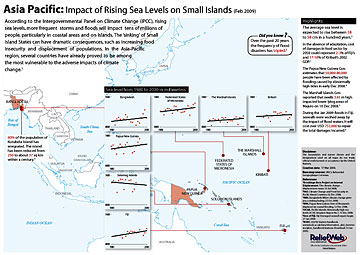
The new study, conducted by Paul Kench at the University of Auckland and Arthur Webb Fiji’s South Pacific Applied Geoscience Commission, must come as relief to many people who are wondering if their grandkids are going to have to grow up somewhere else. But it’s by no means a guarantee that these stable or growing islands are going to be thriving hubs by 2100. The acceleration of rising sea levels — expected to measure somewhere between 7 inches and up to 2 feet in that time span — could overtake that helpful sedimentation, or shift the ecology of an island in a way that makes it uninhabitable.
At Copenhagen last winter, the U.S. pledged to help contribute to a fund that would dole out $100 billion a year by 2020 to nations that need the most help mitigating climate change — if other U.S. demands in climate talks are met. Those details have yet to be ironed out, to put it mildly. Still, that money, in combination with industrialized nations committing to helping resettle environmental refugees when and if the worst happens, would be a start. Because if there is one hard lesson that climate change is teaching us, it’s that together we sink, or together we swim.
