



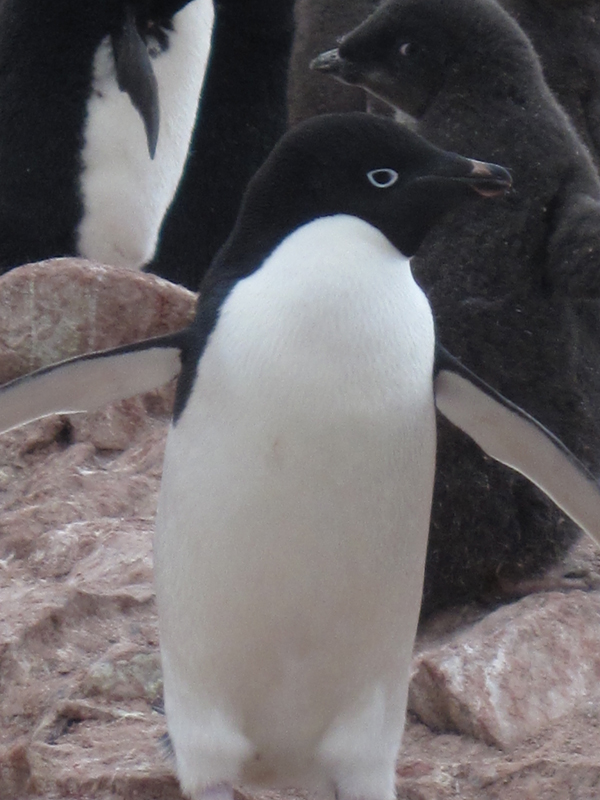
Adelie penguin, Antarctic Peninsula, courtesy Oscar Schofield
The world’s polar regions are warming up faster than the global average, but the western edge of the Antarctic Peninsula is especially steamy. Over the past 50 years, winter temperatures have shot up by an almost unbelievable 6°C—more than five times the global average, according to a paper just published in Science.
The new study, part of a special report on oceans and climate, focuses on the Antarctic Peninsula not only because it represents an extreme, but because it gives scientists a chance to look at a marine ecosystem under rapid climate change (the other polar hotspots, in Siberia and western North America, are well inland).
Rapidly rising temperatures—mostly driven by warmer ocean currents–have transformed the West Antarctic Peninsula’s landscape. The massive ice shelves that sit just offshore at the peninsula’s southern end have begun collapsing en masse . Overall, say the authors, 87% of the region’s glaciers are in retreat, the ice season has shortened by 90 days and, they write ominously, “These changes are accelerating.”
That being the case, it’s not surprising that the creatures who live here are under enormous stress. Adélie penguin populations, which need ice and cold weather to survive, have plummeted by 90% in the northern part of the peninsula over the past three decades, says lead author Oscar Schofield, a marine scientist at Rutgers University, while chinstrap penguins, which prefer more temperate climates, have increased. “The penguin populations near Palmer Station [the largest U.S. base in that part of the continent] have flipflopped,” says Schofield. “The area will probably be completely devoid of Adélies in five or ten years.”
Unfortunately for the Adélies, they don’t migrate very happily. “They tend to come back to the same nesting place every year, so if there’s a shift in climate or food, it hits them pretty hard,” says Schofield. In this case, it’s both: not only has the ice gone into retreat, but so have the krill that form a key part of the birds’ diet—and the krill, in turn, are suffering as changing ocean temperatures have affected the phytoplankton the krill live on.
The Adelies’ main hope, he says, lies in the fact that a few individuals in each population tend to be unusually adventurous and like to roam. “It could be that they’ll find a new area opening up, and form a new rookery. We haven’t seen that yet, but we’re looking for it.”
They’re also looking for evidence of what they expect to be “dramatic changes” in fish, seals, whales and other creatures—although these haven’t been documented yet.
For that reason, and also because the subsurface behavior of the ocean currents driving the local warming are poorly understood, Schofield and his co-authors argue that we need a much more aggressive campaign to monitor the Antarctic ocean intensely. It turns out, for example, that underwater “flooding events” with warmer water happen very rapidly, and far more frequently than a once-a-year ship excursion can capture. Fortunately, says Schofield, a new generation of automated buoys and undersea probes, carrying not only temperature but also salinity and biological sensors, can take up the slack. “It gives us a sustained presence,” he says—and the technology is such that many of the sensors can be controlled and monitored from the U.S. “The operators on campus,” he says, “often get a better view of what’s going on than we do on the ship.”
As for why anyone should care about changes so far from where most of us live, endangered cute penguins are sufficient reason for lots of people. But for the rest of us, the changes going on in the Antarctic may well be a preview for what’s on the way, in a rough sense, for the rest of the world’s marine ecosystems. Coming soon, in short, to a seashore near you.