Should the Oil Spill Be Left to Spill?

Credit: TEDxOilSpill Expedition

God knows this blog—and just about everyone else with a keyboard and Internet access—has been hammering BP and the government for failing to do enough to respond to the Gulf oil spill. But what if the best thing to do when oil leaks is…nothing? That was the tentative conclusion of several British experts at a briefing in London on Monday, who raised the possibility that the best plan could be to try to corral the oil when it’s out to sea but otherwise leave it to disperse and evaporate naturally. They suggested that the all-hands-on-deck response of the White House, Coast Guard and BP—tends of thousands of response workers, thousands of ships, burning oil out to sea and dosing the spill with over 1.5 million gallons of chemical dispersants—might ultimately have more to do with politics than the environment, according to Reuters:

“One of the problems with this spill is that it has gone from the environmental arena into the economic and political arena, so if you ask how bad it is, that depends on which perspective you’re coming from,” said Martin Preston, an expert in marine pollution, earth and ocean sciences from Britain’s Liverpool University.

“Economically, clearly the impact has been very large, but environmentally the jury is still out. One of the tensions between environment and politics is that politicians cannot be seen to be doing nothing, even though doing nothing is sometimes the best option.”

Simon Boxall of Britain’s National Oceanography Center noted that scientists have gone back and looked at the Exxon Valdez—until the Gulf disaster, the biggest oil spill in U.S. history. They found that the areas that were generally left alone had fared better that those that had been cleaned up with chemicals or mechanically. Others noted that all the dispersants than had been added to the oil—which breaks up the spill into smaller particles, ostensibly to allow them to disperse faster—may actually make it harder for bacteria to do their natural work of breaking down the petroleum.
I’ve heard differently. At the TEDxOilSpill conference in Washington yesterday, the microbiologist Ronald Atlas of the University of Louisville—who participated in the Exxon Valdez response—made the opposite point. “Adding dispersants is a good thing [for bacteria],” he told the audience. “If you dilute the oil, that’s good.” But at the same time dispersants come with their own toxic legacy—officials have basically admitted that they see dispersants as the lesser of two evils—but they may be impacting the health of sea life in the deep water, and cleanup workers on the beach. And of course no one has ever tried to use chemical dispersants on the scale that BP is employing in the Gulf—the entire ecosystem has become an uncontrolled science experiment.
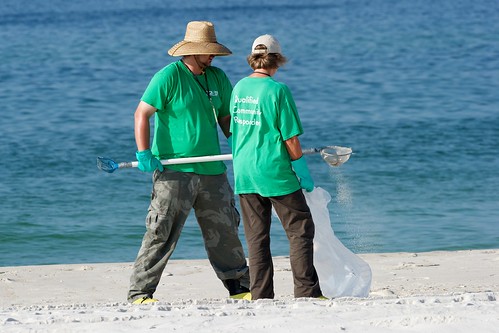
It’s certain, though, that the mechanical cleanup work—the thousands of subcontractors combing the Gulf coast for oil—could be doing more harm than good, especially in southeastern Louisiana’s sensitive marshlands. There any attempt to actually get the oil out seems doomed to fail—like pulling petroleum out of a sponge—and having workers tramping through wetlands grasses will damage an ecosystem that has been under tremendous stress for decades due to coastal erosion. But it sure does look good to have guys in white suits raking at the oil.
It’s impossible to tell just how much of the response is political theater, and how much might actually make a difference. I doubt BP or the Coast Guard fully know either. Thanks to a determined policy of not investing in oil spill response—which has led Kevin Costner to somehow being hailed as a scientific hero—we don’t really have many good ideas to try. (Maybe some hidden geniuses will come out of the woodwork and win the new $10 million XPrize on oil response, but I’m skeptical.) As it happened today BP and the Coast Guard announced that rough seas from Tropical Storm Alex had forced a halt to skimming operations on the water. Here’s the bright side: maybe it won’t even matter.
Related Topics: bacteria oil spill, BP, BP cleanup, BP oil spill, cleanup oil spill, dispersants health effects, dispersants sea effects, Gulf of Mexico, Gulf oil spill hurricane, oil spill containment hurricane, oil spill containment storm, Uncategorized
  • Latest on Ecocentric

    Don Farrall

    Falldown: Radioactive Fallout From Fukushima Posed Little Threat to the U.S.

    Nearly a year after the Japanese tsunami and subsequent meltdown at the Fukushima nuclear plant, the good news is that the risk from radiation doesn’t seem to be as high as many initially feared. Take the Pacific Ocean, for example, where most of the radioactive fallout from the plant eventually ended up. Nicholas Fisher, a marine science professor at New York’s Stony Brook University, took samples of the seawater three months after the accident. He found levels of radiation that were elevated, but still just a fraction of the amount of radioactivity sea life is exposed to from naturally occurring potassium in seawater.

    Nick M Do

    Gasbag: Why No President Can Bring Us $2 Gasoline

    It’s Presidents’ Day as I write this, so if you were lucky enough to have the day off, give some thanks to Washington, Lincoln and all the other chief executives — even stinkers like James Buchanan and Andrew Johnson. Of course in modern American politics, every day is really Presidents’ Day — so central is the occupant of the White House to the perceived state of the nation. Good news or bad news, foreign or domestic, the President gets the credit — and he gets the blame, whether he actually deserves either.

    Bloomberg via Getty Images

    Pipeline Politics: Are the Oil Sands “Game Over” for the Climate? One Study Says No

    There are no shortage of reasons why the Keystone XL pipeline has become such a hot button issue for environmentalists. Many worry about the risks the project could pose to the Ogallala aquifer in Nebraska, where the pipeline was originally designed to pass. Indeed, when President Obama rejected Keystone XL in January, his stated concern was the potential threat to local water supplies.

  • tanboontee

    So, after 10 weeks, the British experts are beginning to talk about the British Petroleum spill, suggesting that doing “nothing” might have been better than what has been done.

    There seems to be an element of Taoism in it, but unfortunately, it might be in the wrong context.

    Would it be possible for the mighty storm Alex to blow away every drop of the leaked oil and all the human sins attached to it?
    (btt1943)

  • dailygoat

    Uhhh, that seems to me to be the most ridiculous idea that has been proposed. Maybe when there is a fire, we should just let it burn down the block. Or let a murderer just kill until he tires of it.

    This is how BP is behaving and it is not acceptable:

    http://www.dailygoat.com/2010/06/republican-rebukes-oil-executivein-news-hell-issues-frost-advisory/

  • http://bodyg.wordpress.com health,diet

    The workers are very hard for the oil and the effectiveness of this, the United States each year there are a lot of oil in Mexico is the flow into the ocean, which was very very sad thing, is not only the flow of something as simple as the ocean , also let our little fish had to reduce the life, no wonder that now are so many natural disasters are actually man to blame, the human let this world more beautiful, but also can make the world more afraid, I will die like human beings, this is a matter of time
    http://diethealth.weebly.com

  • thierrylach

    I wonder if they would come to the same conclusion if the spill were in the English Channel…

  • stevedap

    The leak could likely have been plugged within a couple of weeks after the initial blowout by imploding the well several hundred feet below the seabed : Drill a set of 6″ boreholes 250 feet into the seafloor around the wellhead. Pack the bottom of the boreholes with high explosive and detonate. The pressure wave would collapse thousands of tons of surrounding material and cinch up the well 250 feet below the seabed, effectively stopping the leak. There would be many millions of tons of seafloor material above the imploded well to contain it. The wellhead at the seafloor would not be damaged. An experienced mining engineer could design the “shot” in a day.

blog comments powered by Disqus