



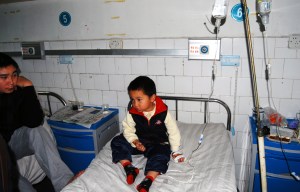
A lead-poisoned child gets treatment in southern China's Hunan province on March 23, 2010 / Associated Press
Environmental NGOs in China and the U.S. are trying to redirect the world’s fixation on the new iPhone 4 to the environmental records of the factories where it and other mobile phones and computers are built in China. In particular, the groups have been revving up pressure on Apple to answer questions about pollution regulation across its supply chain, calling for the U.S. company and its peers to be more transparent about potential oversight at its suppliers’ factories in China.
The calls come on the heels of an April report released by a consortium of 34 environmental NGOs that found several Chinese factories linked to major global IT brands were responsible for heavy metal contamination in their vicinity. After releasing the report, the group asked 29 major brands, including Apple and Vodafone, to provide more information about the Chinese facilities where their products are made. As of June 23, Apple was one of 8 companies who had not responded.
The efforts of Green Choice Alliance, the name that the group of NGOs goes under, to draw attention to the IT industry’s supply chain follows a year of bad news in the department of depressing-fallout-from-China’s-breakneck-economic-growth. In 2009, back-to-back cases of heavy metal poisoning were reported throughout China, in which children seemed to be disproportionately affected. In one month alone, some 2000 cases of children suffering from lead poisoning were reported in Hunan, Yuannan, and Shaanxi provinces, and more have continued to come out this year.
Though those cases were by no means all tied to IT factories, production of mobile phone batteries and printed circuit board (PCB) are both associated with the potentially harmful lead and cadmium. In a sector pushing to do more and more business for companies that want cheaper and cheaper products, it’s not hard to see how shortcuts might be taken leading to environmental oversight and heavy metal biproducts ending up in the soil or water sources of communities where the factories are located. Indeed, the April report found that printed circuit board maker Huizhou Merix Printed Circuits Ltd., whose major clients include Cisco and Motorola, severely violated pollution limits. According to a March 2009 government report, the company directly released waste liquids containing copper at levels over 5000 times above the legal limit, and iron at nearly 200 times above the limit. The report found another PCB maker, Hong Kong Kingboard Chem148, which has one of the biggest market shares in Asia and major global clients including IBM and Intel, to have similar violations.
The report does not explicitly accuse Apple of any wrongdoing, but its writers did ask Apple to provide more information about its own suppliers’ practices. The call for greater transparency comes at a delicate time: Apple already had to stick up for its overseas production after a spate of suicides at the mammoth Foxconn factory, where the iPhone is built, came to light. Over a dozen workers have killed themselves at the Taiwanese company located in Shenzhen this year; as Time.com’s Newsfeed wrote earlier this month, Steve Jobs defended Foxconn’s working conditions at a conference in California: “You go in this place and it’s a factory but, my gosh, they’ve got restaurants and movie theaters and hospitals and swimming pools. For a factory, it’s pretty nice.” (Foxconn has since hiked workers‘ salaries to try to prevent more deaths.)
On the issue of pollution, however, it’s been crickets so far from Jobs and the gang. The Institute of Public and Environmental Affairs, a member of the Green Choice Alliance, has created an online pollution map database in recent years with over 60,000 government-sourced corporate violation records which it says companies like Nike and Wal-Mart are now using to check on their Chinese partners. So why is Apple keeping mum? As Ma Jun, a Chinese environmentalist works for the Institute, writes in an article for China Green News:
With its imagination and large sales, Apple has become the world’s most valuable IT company. However people are starting to have doubts regarding Apple’s silence on heavy metal pollution problems. Has Apple deliberately ignored its issues with environmental supply chain management in order to control costs and maintain price competitiveness?
Maybe; maybe not. But we won’t know until Apple — and other companies in an industry that has a spotty track record on dangerous pollution — say so.
— With reporting by Jessie Jiang