



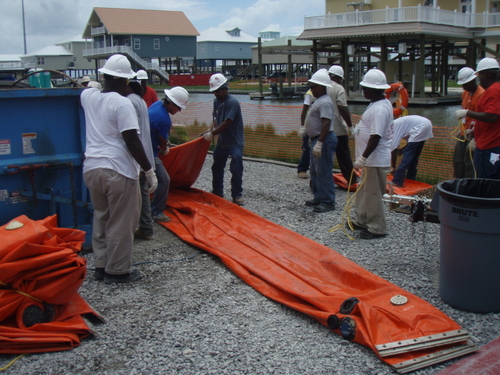
Last week the Coast Guard sent out an announcement to the media: from now on there would be a 20-meter safety zone established around all protective shoreline boom, booming operations and general oil spill response operations taking place in southeast Louisiana. Any ship that comes with 20-meters of the boom could be liable for up to a $40,000 civil penalty, and willful violations could even result in a felony. The justification was that the boom—a vital part of the oil spill response, albeit one with more holes than an Argentinian defense—was being damaged by vandals who would be discouraged by the threat of a five-figure fine or even jail time.
On the face of it, not an unreasonable request. The oil spill response is incredibly complex—tens of thousands of workers, thousands of ships, billions of dollars—and maybe it wouldn’t be a bad idea to keep the public at a safe remove. After all, we wouldn’t expect boats to be allowed near a naval operation or a training excercise? 20 meters isn’t that far—about 66 feet, almost the distance between the pitcher’s mound and the batter in baseball. And the sad thing is that even in the midst of a public tragedy like the oil spill, people do mean, destructive things—look at the number of deadly wildfires that have been caused by arson.
But that’s not how the new rules were taken. Reporters and activists complained, seeing the regulations as a way for BP and the Coast Guard to hide the failures of the oil spill response. It would be tougher to get the pictures of spoiled and broken boom that give the lie to the promise that everything would be done to fix the spill. It would be harder to actually see response workers in action—not that many are talking. CNN’s Anderson Cooper—who has all but taken up residence in Louisiana while covering the oil spill—got it right when he said the new rule bans reporters from “anywhere we need to be.”
The Coast Guard reacted a bit defensively—in a statement on July 4 a spokesperson for Coast Guard Admiral Thad W. Allen touted the hundreds of press conferences the response team had done, the thousands of images and documents they’d posted online. In his press briefing on Tuesday, Allen told me that “the media has unfettered access to the site unless there’s a safety or security issue. What we have found is some acts of vandalism, or had problems, so we have created a safety zone around boom to keep the boats away. That does not mean we don’t allow access to the local media.” And as he went on to point out, the Coast Guard will allow media access inside the safety zone, albeit on a case-by-case basis. This wasn’t a backdoor policy to block the media, Allen said: “We’re trying to keep safe the boom and the moorings This stuff is very scarce right now. This in no way affects access of the media to the spill.”
Yet when I called up the Joint Information Center to find out how serious the boom vandalism problem was, they didn’t have any specific numbers. The Coast Guard officer I spoke to at the Houma command center in Louisiana told me that anecdotally, he’d heard about vandalism—and the Joint Information Center has put out photos of what they say is spoiled boom—but there were no specific numbers on incident reports, for instance, or anything else that might tell us how widespread this problem is. That struck me as surprising: the Coast Guard, like most branches of the armed forces, is fanatic about statistics and numbers, and since the spill began we’ve been bombarded with figures meant to show how huge the response is: the 38,600 personnel involved, the 7,200 vessels, the 275 controlled burns that have been performed on the oil. If the vandalism problem is so severe that the Coast Guard felt the need—more than two months after the spill began—to slap on a major fine for coming near the boom, you’d think they’d have figures. Otherwise, I have to go on trust.
And that’s the problem—trust between the media and the BP/government team leading the oil spill response is largely gone. It was forfeited long ago, when BP played games with the true extent of the spill and were slow to even release underwater video of the leak; when the government questioned the credibility of independent researchers who had found evidence of underwater oil plumes, evidence that turned out to be correct; when BP and its contractors, with the apparent support of local police in the region, kept media away from oiled beaches and wildlife and created an atmosphere where cleanup workers felt they’d lose their jobs if they talked; when the vast gap between what BP has claimed to be able to do in the case of an oil spill and what it can actually do became obvious; when BP even sent a group of in-house “reporters” to bring back absurdly optimistic stories of the spill. It’s impossible now for the media to take at face value anything on the oil spill that comes from official sources—the trust is gone, and no amount of official press conferences will change that. (If you really want to ramp up your outrage on the subject, read Glenn Greenwald’s column.)
And it’s not just the media—trust has been shattered for the people of the Gulf as well. You can see that in the protest signs that are sprinkled throughout the Gulf region, decrying the effects of the oil spill. Or you can see it on Twitter, where public rage has given way to something closer to paranoia: fears that the government and BP are somehow in league to minimize the effects of the spill, that the Environmental Protection Agency is suppressing evidence of the toxicity of chemical dispersants, that BP and the oil spill responders are burning wildlife to hide the evidence of the oil spill’s toll. (Oh, wait, that one might actually be true.) BP and the government, by too often being opaque with the facts—if not downright lying—have created an atmosphere of deep distrust.
For BP, it might not really matter—the company’s reputation is shot, but as an oil company, frankly, why should they care? BP isn’t McDonald’s or Pepsi or Apple—a consumer company that needs to keep its customers happy. They’re an oil company that makes a product we can’t go without—if they survive this, they’ll go back to selling us oil and we’ll go back to buying it, barely differentiating them from any other oil company. (It’s not like the Valdez spill had much long-term impact on Exxon, which is only one of the world’s most profitable corporations.) It’s been obvious from the start that BP has looked at the oil spill through the lens of legal risk, not reputational risk—as McClatchy reported this week, BP moved quickly to hire all the best oil spill experts, to make sure they couldn’t testify against the company in coming litigation. They’re not really concerned about the truth—they’re concerned about what’s provable in a court of law.
But the federal government should care and should be more open. Not just because it’s right, but because the erosion of public trust over this oil spill could have deeper ramifications for how people feel about government. We’ve already seen how failures of regulation—dating back to several Administrations—helped set the table for the Deepwater Horizon spill. And the failure of the government to quickly the stop the spill, its seeming impotence, already has the public wondering what Washington really can do, as David Brooks pointed out in a column last month. But if we lose trust in Washington as well—that doesn’t come back.