



Okay, I know it’s weird to keep writing about Greenland from Hong Kong, but what can I say. Greenland’s constantly shifting landscape is a busy place.
The latest spasm of geography on the world’s largest island was recorded last week, when between July 6 and 7, scientists monitoring satellite images of Jakobshavn Isbrae glacier in west Greenland saw that it lost a 2.7-square-mile chunk of ice in a 24 hour window. Here’s an aerial view of the back-t0-back images, posted by NASA.
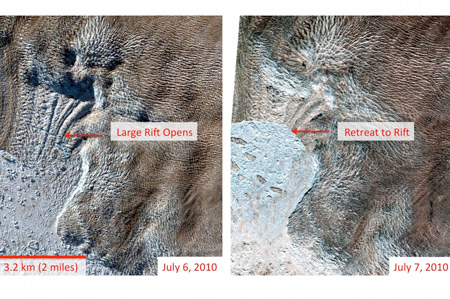
courtesy of Digital Globe
You can clearly see where the ice broke off in the image on the right. It’s not an unprecedented event in terms of the size of the calving, but the fact that it happened after an unusually mild winter when the annual sea ice didn’t form in that area is worrying. Says Thomas Wagner, cryospheric program scientist at NASA Headquarters:
“While there have been ice breakouts of this magnitude from Jakonbshavn and other glaciers in the past, this event is unusual because it occurs on the heels of a warm winter that saw no sea ice form in the surrounding bay…While the exact relationship between these events is being determined, it lends credence to the theory that warming of the oceans is responsible for the ice loss observed throughout Greenland and Antarctica.”
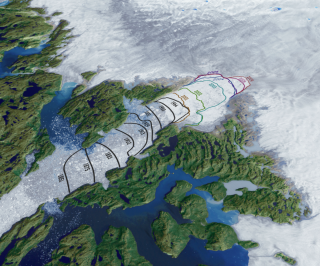
Jakobshavn, a tongue of the Greenland ice sheet off western Greenland, has retreated six miles in the past 10 years. That’s pretty dramatic stuff, even in a part of the world that has long been the canary in the cold mine for climate change. According to NASA, scientists think 10% of the ice loss from Greenland is happening at Jakobshavn, and that it’s the single largest contributor to rising sea levels across the northern hemisphere. This is an interesting illustration of Jakobshavn’s major calving events since 1850. (1851 is the black line on the left; 2009 is the red line at the far right.)
Yikes.
In the summer of 2003, when I visited Greenland for the first time, I was flying in a helicopter over the waters off the island’s east near Tasiilaq, and the Danish pilot pointed out to me the jigsaw puzzle of icebergs floating downstream in the waters below us. He said there were more than he’d ever seen, as glaciers further north were breaking off more and more. “Things are pretty well messed up,” I remember him telling me with a very Nordic stoicism.
That was seven years ago, on a totally different part of the island. Looks like things aren’t getting much better, and when I see huge irreversible events like this one at Jakobshavn, I have to say, I’m don’t feel very stoic.