
In Hong Kong, One Paradise Lost

From the Department of Gripes:

You might not think of Hong Kong as a trove of natural serenity, but actually, the seven million people living here are squished into a remarkably small area. We all live piled on top of each other and jockey for space on impossibly narrow sidewalks while about 75% of the land of the Special Administrative Region is undeveloped, lush countryside, full of creatures like wild cows, (dog-eating) pythons and aggressive monkeys that I advise you not look in the eye. From an evolutionary perspective, humans are really losing the battle in this little semi-autonomous chunk of China.

Personally, I like it that way. So it was with a heavy heart that I picked up today’s South China Morning Post (Hong Kong’s big English daily) to read a front page story on the desecration of one of the finest untouched corners of the city. Tai Long Wan beach, whose Cantonese name translates roughly as “big wave bay,” is a sweeping crescent of white sand lapped by clear blue waters. It takes some serious effort (and, in summer, an unspeakable amount of sweat) to get out there by subway, bus, taxi and foot, and that is what, until now, has kept it so good. That, and the fact that it’s part of Sai Kung East Country Park, an area set aside for nature conservation.
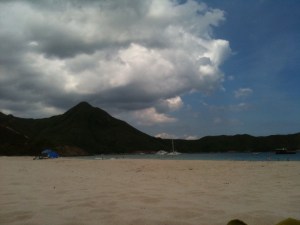
Or so we thought. Through a zoning loophole, the SCMP reported today that a large private residence is now under construction directly behind Tai Long Wan. Local businessman Simon Lo Lin-shing, chairman of Mongolia Energy Corporation and Vision Values Holdings, has acquired several plots of an abandoned village for a total of about $2 milion in a small area that falls outside the park zoning laws, and therefore is not subject to planning regulations or EIAs.

The bulldozers he has hired to start building there have already started clearing land. An unnamed spokeswoman for Vision Values Holdings told the paper that there were no plans for any “large-scale works,” and that because the owner was “very green” himself, the land would be developed in a low-profile way.

Sigh. There’s nothing illegal necessarily going on here, but it’s always depressing when loopholes like these can be found at the right price. It sounds like the property buyer worked fairly hard to piece together this land from its original owners, and it’s hard to imagine that at some point along the way, his efforts didn’t come to the attention of somebody in public office who could have raised a red flag. It’s particularly bleak news when a totally separate scandal involving the wheelings-and-dealings of the local property market has been unfolding.

Anyway, this is not the first project in Hong Kong to crop up in areas that should be under stricter development laws, and it won’t be the last. But let’s hope it is the last unspoiled public beach that somebody with enough cash gets to put in their own backyard.

The monkeys, for their part, are not going to be amused.

Related Topics: Uncategorized
  • Latest on Ecocentric

    Joe Raedle / Getty Images

    How Smart Paint Saves Bridges

    Up to 73,000 American bridges are considered “structurally deficient,” and the consequences of that can be as terrible as they seem. The most recent large-scale bridge disaster in the U.S. occurred in 2007, when the Mississippi River Bridge in Minneapolis collapsed during rush hour, killing 13 people and injuring 145. Scarily, the bridge had earned its structurally deficient label 17 years prior, but that simply meant it would, in theory, be replaced by 2020, depending on the availability of funds.

    NASA

    Drill, Baby, Drill: Russian Scientists Reach a Massive Underground Lake

    If life were a Michael Bay movie, the moment this week when Russian scientists finally drilled into the subglacial Lake Vostok in Antarctica would immediately be followed by the sudden and frightening appearance of unfrozen aliens, or the Predator, or the Decepticons, or giant prehistoric piranhas, and only Shia LaBeouf—plus leggy starlet to be named later—could save the human race from extinction.

    Danita Delimont

    Island Blues: A Caribbean Country’s Troubled Experiment with Geothermal Power

    St. Kitts and Nevis, with a population of just over 50,000 and covering a mere 100 sq. mi. — one and a half times the size of Washington, D.C. — is the smallest sovereign nation, by size and population, in the Americas. The two-island federation in the east Caribbean is perhaps best known for welcoming wealthy tourists to its pristine beaches and luxury resorts.

  • scheung127

    Mr. Simon Lo’ tactic is clear.While he has right to take care of his land (the fields and trees), he has no right to block out the stream (government land). While he has stopped the construction due to public pressure, the next time he submit application for construction, due to the fact that the 100,000 sq ft of land became barren (due to his current unlawful excavation) it will be easier for him to get the permit then.

    This is a known tactics for wealthy people here in Hong Kong. The government simple is not taking up the role as the enforcer. This explain why the local Face Book site received 40,000 members in 5 days opposing the construction. When the government officials don’t come from election, this is just a regular job to them. They have not been representing or defending public interest in many cases.

  • kumarhk

    Ditto the previous comment – while the government’s preservation of Hong Kong’s country parks and such is admirable, they really need to stamp out these loopholes.

    At the same time, though, I wonder what will happen when our population is simply no longer able to fit into the city and the new towns. Sure, we can develop more new towns on the outskirts of Hong Kong, but at some point every bit of land that is not part of that 75% will be exhausted. Then we’ll really have a problem on our hands.

blog comments powered by Disqus