
Will Southeast Asia’s Hydro Rush Drown the Giant Catfish?

AP
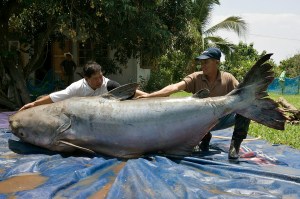
RESTRICTED TO EDITORIAL USE / MANDATORY CREDIT "AFP PHOTO / WWF / Suthep KRITSANAVARIN" NO SALES FOR MARKETING OR ADVERTISING CAMPAIGN -- (FILES) This undated handout photo provided by the World Wildlife Fund (WWF) on July 28, 2010 shows a Giant Mekong Catfish, weighing 292kg that was caught by local fishermen in Chiang Khong, northern Thailand in 2005. One of the world's biggest freshwater fish could be driven to extinction if plans to build hydropower dams on Southeast Asia's longest river go ahead, wildlife organisation WWF warned on July 28, 2010. Numbers of Mekong giant catfish -- believed to grow up to three metres (9.9 feet) long -- would "collapse" if it was blocked from its spawning grounds on the river through China, Laos, Thailand and Cambodia, the group said. AFP PHOTO / WWF / Suthep KRITSANAVARIN / HO (Photo credit should read Suthep Kritsanavarin/AFP/Getty Images)(Photo Credit should Read /AFP/Getty Images)

It’s hard to overstate the fever for hydroelectric power that has infected southeast Asia in recent years. Hydro power has more than tripled across the region since 1980, a growth that is pinned primarily to the mighty waters of the Mekong, the huge and powerful river that winds its way from the Tibetan–Qinghai Plateau, through Burma, Laos, Cambodia, and Thailand, eventually emptying into Vietnam. Three large hydroelectric dams have been build along the mainstream Mekong in China today, and at least 16 more are under construction or consideration, including in the wildly diverse lower Mekong area.

A new World Wildlife Fund (WWF) report out this week raises a big red flag over one of the potential casualties of this push for power: the Mekong giant catfish. This bottom-dwelling behemoth, which grows nearly 10 feet long and can weigh in at over 770 pounds, is already critically endangered, and one of the aforementioned dams, now in its final stages of approval, threatens to deliver the threatened fish its coup de grace. (Sans the grace.)

Not a whole lot is known about this rare beast that lives in the Mekong’s murky depths. But scientists believe the giant catfish migrates from Cambodia’s Tonle Sap Lake to spawn in Laos and Thailand. Though the river’s tributaries have been dammed, the main, lower portion of the Mekong, where the catfish’s migration takes place, has not been harnessed for hydroelectricity — yet. The dam in Laos’ Sayabouly province would be the first. It would also create a physical barrier that the giant catfish would not be able to cross to procreate, says WWF.

It’s very bad news for the world’s third largest fish, and several other big aquatic species in the area. The giant catfish’s numbers have already plummeted 90% in the 20 years, challenged by the damming of the Mekong tributaries, overfishing and silt, among other things.

It’s tough, because hydropower is a clean, renewable energy source — something that Asia certainly could use more of. The Mekong River Commission, a joint body that the governments of Thailand, Cambodia, Vietnam and Laos established in 1995, says it is committed to the sustainable development of the Mekong basin, but balances that pledge “with the economic and poverty alleviation priorities of the MRC Member Countries.” The river runs through some of the most impoverished communities in Asia, and generating private investment in these areas is high on each government’s to-do list.

But where to draw the line? The damming of the Mekong proper is expected to disrupt the livelihoods of the millions of people who survive on the Mekong, as well as make the lower delta region more vulnerable to erosion as sediment and silt that would normally flow downstream is blocked. As for the giant catfish, the adults of the species may only number in the hundreds now. If those remaining few can’t get upstream to spawn in a few years, another living creature of mythical proportions will become that and only that — a myth.

Still curious? Check out TIME Asia’s 2007 cover story on the Mekong.

Related Topics: Asia, hydroelectric power, Conservation, Energy, Wildlife
  • Latest on Ecocentric

    Joe Raedle / Getty Images

    How Smart Paint Saves Bridges

    Up to 73,000 American bridges are considered “structurally deficient,” and the consequences of that can be as terrible as they seem. The most recent large-scale bridge disaster in the U.S. occurred in 2007, when the Mississippi River Bridge in Minneapolis collapsed during rush hour, killing 13 people and injuring 145. Scarily, the bridge had earned its structurally deficient label 17 years prior, but that simply meant it would, in theory, be replaced by 2020, depending on the availability of funds.

    NASA

    Drill, Baby, Drill: Russian Scientists Reach a Massive Underground Lake

    If life were a Michael Bay movie, the moment this week when Russian scientists finally drilled into the subglacial Lake Vostok in Antarctica would immediately be followed by the sudden and frightening appearance of unfrozen aliens, or the Predator, or the Decepticons, or giant prehistoric piranhas, and only Shia LaBeouf—plus leggy starlet to be named later—could save the human race from extinction.

    Danita Delimont

    Island Blues: A Caribbean Country’s Troubled Experiment with Geothermal Power

    St. Kitts and Nevis, with a population of just over 50,000 and covering a mere 100 sq. mi. — one and a half times the size of Washington, D.C. — is the smallest sovereign nation, by size and population, in the Americas. The two-island federation in the east Caribbean is perhaps best known for welcoming wealthy tourists to its pristine beaches and luxury resorts.

  • ryimsut

    For a cheaper electricity rate, up to 60 millions people within the Mekong basin, will be “directly” affected by environmental degradation brought on by dams. Small price to pay? Think again as it is much cheaper to light candle than pay high price, very high environmental prices, for a cheaper electricity–which ordinary people within the Mekong basin has NO ACCESS to begin with, but pay the highest toll.

    Ronnie Yimsut
    Author, Activist, Landscape Architect,
    Environmental Consultant (and much more)

blog comments powered by Disqus