



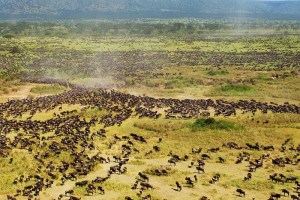
Credit: Felix Borner
One of the unwritten rules of the industrialized age is that the more humans get to move around, the less animals do. Humanity’s unprecedented migrations – to look for jobs, escape from wars, mine for natural resources and visit new places – are, in fact, creating more and more roadblocks for the animals with which we share space.
Once in awhile, the animals win a round or two. In the early 1960s, the Tanzanian government tried to stop one of the greatest animal migrations on the planet – the journey of nearly 2 million wildebeest, zebra, gazelle and impalas from the Sergenti plains in Tanzania to the hills of Kenya. Every year, the river of beasts puts the safety-in-numbers adage to the ultimate test as they migrate 1800 miles looking for fresh grass and water, followed all the way by predators. At the time, officials erected miles of wire fence to try to steer the animals in another direction. They promptly trampled the fence flat.
Good thing, too: today that migration brings a lot of money to the areas of Tanzania and Kenya that the animals pass. Figuring out where they’re going to be at any given point in the year has become a fine art, as has the eco-tourism business catering to nearly 100,000 tourists who come from around the world to watch the spectacle every year.
But humans, unlike elephants, tend to forget. The government of Tanzania, in an effort to develop its national road system, is proposing a highway be built through the northern part of the Serengeti National Park – a move that conservationist groups who track wildlife in the area say could be devastating. They predict that the Arusha-Musoma highway, slated to be built in 2012, would block access to the Mara River, a critical water source during the dry season, causing the wildebeest population to collapse as well as cause human and animal collisions. The groups say the highway would also cut off the Masaai Mara National Reserve, Kenya’s most important tourist destination, from the animals’ route.
The project has attracted its share of controversy. According to Tanzania’s Daily News, the nation’s president had to intervene to insist that the project move ahead because of the positive economic benefit that roads bring. True enough, it would undoubtedly make life easier for the people living in the region, and considering that some of the opposition comes from foreign conservation groups, it’s not hard to understand why the government has stood its ground. Markus Borner, the Africa Program Director for the Frankfurt Zoological Society, which along with the New York-based Wildlife Conservation Society and the Zoological Society of London, opposes the Arusha-Musoma highway, writes in an Aug. 25 press release:
“We recognize that there is an obvious need for infrastructure development in Tanzania. A far better option than the current proposal is placing a road to the south of the park. Such a road would be both cheaper to construct and would serve a much larger number of people without interrupting the migration and jeopardizing the iconic status of the Serengeti National Park.”
It’s not the first time the park has been down this, er, road. The Serengeti National Park struggles today with managing poachers who continue to hunt illegally in the park’s protected land. Many residents who live near the park have deep resentment that they are not allowed to hunt on the land – or kill dangerous animals hanging out near their homes — so that rich foreigners can come ogle the wildlife. As a compromise, park officials have rolled out mixed-use “buffer zones” where local hunting is allowed, but managed.
There is not a lot of research yet on how that has worked out at a conservation level, but it does point to a successful track record in the region of figuring out ways to improve life for human residents while protecting the park and its four-legged inhabitants. They have, after all, been neighbors for a few million years. Surely there is a solution that lives up to the park’s namesake, Siringitu — or “the place where the land moves on forever.”