



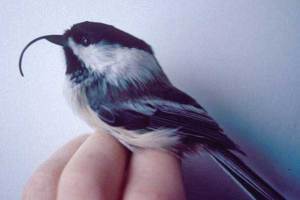
Courtesy of USGS
Call it the deformed canary in the coalmine. Scientists have found that several species of wild birds in the Pacific Northwest and Alaska are growing deformed beaks at rates never before recorded. The birds, whose beaks are severely elongated, curved or even crossed, have developed what’s called avian keratin disorder, and though the USGS biologists who released their findings this month have not pinpointed its cause, they believe it could signal a graver environmental problem.
Beak abnormalities are rare in adult birds. The deformities, which sometimes also affect birds’ feed and feathers, can have many causes, from parasitic or viral infections to environmental contaminants. But when multiple species across a region – in this case the Pacific Northwest and Alaska – are affected with deformities that are so similar in nature, it could very well be a factor in their environment causing the change.
In the past, when deformities have been found in vast group of birds like this one (called an epizootic in animal speak; our equivalent of an epidemic), it has, indeed, been the first tip off that something in their environment was askew. Hatchlings of fish-eating birds and raptors in the Great Lakes that have been exposed to high levels of PCBs and other toxins have had wide instances of beak deformities. They also occurred in birds in California exposed to selenium (Se) in agricultural runoff. In that case, Se levels in agricultural drainage exceeded hazardous levels, and by scientists gathering data on deformities of the eye, feet or legs, beak, brain, and abdomen in ducks, grebes, and coots, the community was alerted to the widespread problem and it was eventually addressed at a policy level. (Read more about it.)
For the black-capped Chickadees and the Northwestern Crows of Alaska and the Northwest, this is not a new problem. The beak disorder (which keeps the birds from eating and cleaning themselves properly, poor little guys) has been steadily growing since abnormalities were first spotted in the species in the late 90s. The USGS, after releasing its findings, says it will continue to study potential causes of the epizootic. Have a look at a gallery of the birds here.