
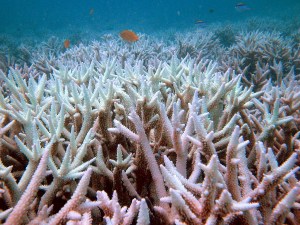
Is the Caribbean Heading for Another Record Year in Coral Loss?

Bleached coral in the Great Barrier Reef in 2006. (AP/Ove Hoegh-Guldberg)
Bleached near the Keppel Islands in the Great Barrier Reef in 2006. (AP/Ove Hoegh-Guldberg)

Anybody who has been visiting coral reefs for the past 20 years or so will tell you that the scene underwater pales – quite literally – in comparison to what it used to be.

New research published in PLoS ONE yesterday shows that coral bleaching in the Atlantic and the Caribbean in 2005 was the worst bleaching event ever recorded in the region. That year, more than 80% of the corals studied by researchers from 22 countries bleached, and 40% of it died. Scientists at the National Oceanic and Atmospheric Administration (NOAA) think this year could rival 2005. Corals in the Caribbean are already bleaching again – in some cases worse than five years ago.

When you’re snorkeling over a coral reef, it’s easy to think of the coral formations you see as inanimate parts of the landscape. They’re not. In fact, corals are an exquisitely refined species; a symbiotic partnership of coral polyps that host a special kind of algae, which in turn photosynthesizes food for the polyps to grow and build themselves. The species as a whole (there are many different kinds of corals in coral reefs) are the backbone of their environment, providing food and shelter to thousands of other species, from sea cucumbers all the way up the food chain to sharks and humans. For us, coral reefs, by NOAA’s estimates, generate up to $375 billion every year in jobs, food and tourism.

Despite that critical role, corals are extremely finicky. They don’t respond well to change – particularly changes in the water they live in. When water temperatures rise, the corals expel their guest algae, causing the structure to turn white, or bleach. If the water continues to stay warm, the corals eventually starve to death without the algae’s food, and with the corals death the entire system that lives on them starts to follow. Add this to the host of other challenges that coral reefs face – oceans’ increasing acidity (they don’t like that either), water pollution and overfishing – and some scientists think coral-dominated reefs could disappear in the next 40 years.

Bleaching has been on coral watchers’ radars since 1998, when the world’s worst recorded incident of global bleaching occurred and 16% of the world’s reefs died. This year things are looking grim too. (Here’s a map where you can see bleaching hot spots this year in the Caribbean as monitored by NOAA.) While the majority of corals recover from bleaching, re-integrating algae once water temperatures cool down, repeated occurrences of periods of stress could affect the animals’ ability to recover.

What can we do to ensure that reefs aren’t wiped in a matter of decades? Well, getting a greener energy economy online as fast as possible to curb the trend of rising ocean temperatures is the long answer. The short answer probably lies in mandating that the sectors that profit directly from coral reefs — primarily fishing and tourism — get more involved. There are a couple of very cool programs like Reef Check and CoralWatch that train tourists how to visually monitor coral reef health and report their findings back to the organizations. That helps build statistics and drive education, which in turn might encourage the market to favor dive operators and seafood brands that operate more sustainably in their delicate environments.

Is that enough? Probably not. Is it better than nothing? Without question.

Related Topics: bleaching, Caribbean, coral, NOAA, Climate Science, Oceans, Water
  • Latest on Ecocentric

    Don Farrall

    Falldown: Radioactive Fallout From Fukushima Posed Little Threat to the U.S.

    Nearly a year after the Japanese tsunami and subsequent meltdown at the Fukushima nuclear plant, the good news is that the risk from radiation doesn’t seem to be as high as many initially feared. Take the Pacific Ocean, for example, where most of the radioactive fallout from the plant eventually ended up. Nicholas Fisher, a marine science professor at New York’s Stony Brook University, took samples of the seawater three months after the accident. He found levels of radiation that were elevated, but still just a fraction of the amount of radioactivity sea life is exposed to from naturally occurring potassium in seawater.

    Nick M Do

    Gasbag: Why No President Can Bring Us $2 Gasoline

    It’s Presidents’ Day as I write this, so if you were lucky enough to have the day off, give some thanks to Washington, Lincoln and all the other chief executives — even stinkers like James Buchanan and Andrew Johnson. Of course in modern American politics, every day is really Presidents’ Day — so central is the occupant of the White House to the perceived state of the nation. Good news or bad news, foreign or domestic, the President gets the credit — and he gets the blame, whether he actually deserves either.

    Bloomberg via Getty Images

    Pipeline Politics: Are the Oil Sands “Game Over” for the Climate? One Study Says No

    There are no shortage of reasons why the Keystone XL pipeline has become such a hot button issue for environmentalists. Many worry about the risks the project could pose to the Ogallala aquifer in Nebraska, where the pipeline was originally designed to pass. Indeed, when President Obama rejected Keystone XL in January, his stated concern was the potential threat to local water supplies.

  • coloradobob

    The scale of the reef die-off in the Coral Triangle :

    Dr Andrew Baird of the ARC Centre of Excellence for Coral Reef Studies and James Cook Universities.

    “So far around 80 percent of Acropora colonies and 50% of colonies from other species have died since the outbreak began in May this year,” he added.

    This means coral cover in the region could drop from an average of 50% to around 10 percent, and the spatial scale of the event could mean it will take years to recover.

    Size :

    The area covers roughly six million square kilometers (2.3 million square miles) of sea bordering Indonesia, Malaysia, Papua New Guinea, Philippines, Solomon Islands and East Timor.

    “The scale is huge,” Baird said, adding that the coral triangle and regions around it were undergoing dramatic changes.

    Global Reports of the 2010 Coral Bleaching Event

  • coloradobob

    ” Corals in the Caribbean are already bleaching again – in some cases worse than five years ago. ”

    The report from Panama posted Oct. 22, 2010

    “I’ve never seen bleaching like [it] in Panama,” said Nancy Knowlton, a coral biologist at the Smithsonian Tropical Research Institute in Panama who has been studying the local flora for 25 years. She and colleague Hector Guzman have seen massive reefs die in recent weeks in the enclosed lagoon of Bocas del Toro in Panama after becoming coated with giant sheets of slime, the remains of dead microorganisms. “This is NOT a normal condition on reefs, even bleached reefs. Where last year there were healthy corals, this year there was only gray ooze,” she wrote in an e-mail.

    Hot Temperatures Could Mean Worst Caribbean Coral Die-Off in History

    http://coloradobob1.newsvine.com/_news/2010/11/12/5457136-global-reports-of-the-2010-coral-bleaching-event-?threadId=1131917&commentId=19438365#c19438365

  • coloradobob

    A Sept 22. 2010 report from Kuwait -

    KUWAIT CITY // A group of Kuwaiti divers has reported bleaching in more than 90 per cent of the country’s coral reefs – a sign that the coral is either sick or dead. “This is really bad,” Dari al Huwail, a member of Kuwait Dive Team, said. “Before Ramadan, it seemed normal; there were signs of bleaching, but they were not unusual, at least to me.” After the holy month, “we went diving for a conservation project and were shocked to discover how massive the bleaching was”.

    Kuwait’s coral is dying as sea warms up

    http://coloradobob1.newsvine.com/_news/2010/11/12/5457136-global-reports-of-the-2010-coral-bleaching-event-?threadId=1131917&commentId=19438365#c19438365

blog comments powered by Disqus