
Population: Is the World Ready for 7 Billion People?

Some time late in 2011—at least according to the people-crunchers at the U.N. Population Reference Bureau—humanity will reach a new demographic milestone with the birth of the 7th billion living person. (As a measure of just how fast global population is growing, the 6th billionth living person—Bosnian Adnan Nevic—is only 11.) You can expect the event to be marked by the usual Malthusian worries—can the planet Earth really support 7 billion people, especially with the population expected to top 9 billion by mid-century? With some 1.5 billion people already living on less than $1.25 a day, nearly 1 billion people hungry and the natural world already heavily damaged, are we on the path to destruction?

That’s the question the environment writer Robert Kunzig tackles in a cover story on population for National Geographic magazine. (I’ll excerpt a bit below, but it’s a great piece and worth reading in its entirety—in fact, consider picking up the issue, which tackles the 7 billion question with photos, articles and graphics.) Kunzig notes that global population has grown astoundingly fast during most of our lifetimes—while it took all of human history to around 1800 for the global population to reach 1 billion (a little Black Death here and there didn’t help), it will take a little more than 50 years for the world’s numbers to grow from 3 billion to 7 billion. A U.N. graph shows how fast population has grown, and where it might be headed:
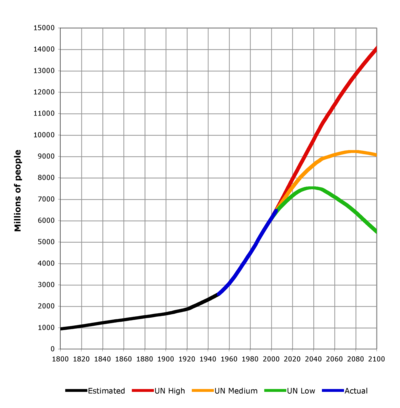
That rapid increase is due to the demographic transition—and on the surface, it’s a sign of human progress. In the past, high fertility rates were the norm around the world, as women had to have large number of children to ensure that at least a few them would survive into adulthood. (That’s often still the case in extremely poor, heavily rural countries like Niger, where the average woman has seven children.) Eventually, though, child mortality declined thanks to advances in medicine and sanitation. As women adjusted to the new reality—and as families moved from farms to cities, where additional children were more of an economic burden than a boon—the fertility rate dropped, but that took a generation or so, and in the meantime population exploded. (Suddenly there were lots more surviving children who could then go and reproduce themselves.) The U.S., Europe and other rich countries have already gone through the transition—in most well-off countries fertility is around or even well below the replacement rate of 2.1 children per woman—and it’s begun to happen in all but the poorest developing countries as well. (China, thanks to the one-child policy, put itself through an accelerated demographic transition.) But the transition will take a while to play itself out, and global population will keep growing rapidly, albeit unevenly—for the next several decades, eventually reaching a level as high as nearly 11 billion or 8 billion by 2050, depending on how fertility rates change in the years ahead.

Either way that seems to be a lot of people—and most of them will be born in poor developing nations, to parents already struggling to support themselves. If you’ve ever visited the urban slums outside growing megacities like Bombay or Lagos you might wonder how they could take any more people—yet they’ll continue to proliferate like bacterial cultures. Those teeming slums seem to provoke a visceral disgust among the thinkers who worry most about population—like Paul Ehrlich, the author of The Population Bomb, whom Kunzig quotes:

I have understood the population explosion intellectually for a long time. I came to understand it emotionally one stinking hot night in Delhi a couple of years ago… The temperature was well over 100, and the air was a haze of dust and smoke. The streets seemed alive with people. People eating, people washing, people sleeping. People visiting, arguing, and screaming. People thrusting their hands through the taxi window, begging. People defecating and urinating. People clinging to buses. People herding animals. People, people, people, people.

As Kunzig notes, that was written in 1966, when India only had 500 million people—today it has 1.2 billion, and it is projected to have over 1.7 billion by mid-century, which would make it the most heavily populated nation on Earth. But the question isn’t whether we will literally have enough space for more people—Kunzig points out that if 9 billion people were spread out around the habitable parts of the planet, the entire Earth would still have only half the population density of France. The fear—from Malthus to Ehrlich—is that we won’t be able to support ourselves, that there won’t be enough food, water or energy to go around, as Kunzig wonders:

Many people are justifiably worried that Malthus will finally be proved right on a global scale—that the planet won’t be able to feed nine billion people. Lester Brown, founder of Worldwatch Institute and now head of the Earth Policy Institute in Washington, believes food shortages could cause a collapse of global civilization. Human beings are living off natural capital, Brown argues, eroding soil and depleting groundwater faster than they can be replenished. All of that will soon be cramping food production. Brown’s Plan B to save civilization would put the whole world on a wartime footing, like the U.S. after Pearl Harbor, to stabilize climate and repair the ecological damage. “Filling the family planning gap may be the most urgent item on the global agenda,” he writes, so if we don’t hold the world’s population to eight billion by reducing fertility, the death rate may increase instead.

Eight billion corresponds to the UN’s lowest projection for 2050. In that optimistic scenario, Bangladesh has a fertility rate of 1.35 in 2050, but it still has 25 million more people than it does today. Rwanda’s fertility rate also falls below the replacement level, but its population still rises to well over twice what it was before the genocide. If that’s the optimistic scenario, one might argue, the future is indeed bleak.

I wrote earlier this week about the debate between Malthusians and Cornucopians—the economists who believe that human ingenuity, responding to human need, always prevails to find new resources to match rising populations. It’s an open question for the future, though so far the Cornucopians have been proven right. It’s worth noting that while we worry about the effects of overpopulation in the future, humanity was far worse off by every material standard in the centuries before the Industrial Revolution, when the global population was a fraction of what it is today. As Kunzig writes, the future of humanity—and of the planet we live on—will have less to do with absolute numbers that it will with how we choose to live:

For centuries population pessimists have hurled apocalyptic warnings at the congenital optimists, who believe in their bones that humanity will find ways to cope and even improve its lot. History, on the whole, has so far favored the optimists, but history is no certain guide to the future. Neither is science. It cannot predict the outcome of People v. Planet, because all the facts of the case—how many of us there will be and how we will live—depend on choices we have yet to make and ideas we have yet to have. We may, for example, says [population biologist Joel] Cohen, “see to it that all children are nourished well enough to learn in school and are educated well enough to solve the problems they will face as adults.” That would change the future significantly.

Indeed, growing populations won’t be the only demographic challenge the world faces in the decades to come. Remember how I said that population was growing globally but unevenly? Even as a country like India will likely need to cope with 500 million new people between now and mid-century, most rich nations—where the fertility rate is below replacement level and people live longer and longer—will need to cope with extreme aging. As the 2010 World Population fact sheet shows (download a PDF here), in Japan, Italy and Germany there are already only 3 working people to support every 1 pensioner. Compare that to sub-Saharan Africa and the Middle East, where the ratio is closer to 25 to 1. That disparity will only grow in the future, exacerbating budget headaches and skewing economies. In the U.S., for example, spending on Social Security and Medicare is expected to rise from 8.4% of GDP today to 14.5% by mid-century.

So here’s the planet we could have in 2050: an overpopulated, overstressed developing world and an aging, economically stagnant developed world, with inequality even larger than it is today. Is there any way to escape that fate? While development and education will be incredibly important (especially for women—literacy is one of the best ways to reduce fertility), the answer may end up being immigration. Think about it—in the future the developed world will lack young workers, and the developing world will have an excess of that resource. Immigration could be a way to balance demographics and economics—alleviating population pressure in the poorer parts of the world while jump starting aging developed nations. The U.S. already does this—immigration will provide most of American population growth. It would be a radical solution, given the political resistance to increased immigration in much of the rich world. (If you think it’s a hot topic in the U.S., try Japan, which steadfastly resists assimilating foreigners, despite the dire threat posed by an aging population.) But it might be the only way to save our overpopulated planet.

More from TIME on population:

What Condoms Have to Do With Climate Change

Population: The Numbers Game

Related Topics: aging, climate change, demographic transition, immigration, megacities, natural resources, overpopulation, Paul Ehrlich, population, Thomas Malthus, Uncategorized
  • Latest on Ecocentric

    Don Farrall

    Falldown: Radioactive Fallout From Fukushima Posed Little Threat to the U.S.

    Nearly a year after the Japanese tsunami and subsequent meltdown at the Fukushima nuclear plant, the good news is that the risk from radiation doesn’t seem to be as high as many initially feared. Take the Pacific Ocean, for example, where most of the radioactive fallout from the plant eventually ended up. Nicholas Fisher, a marine science professor at New York’s Stony Brook University, took samples of the seawater three months after the accident. He found levels of radiation that were elevated, but still just a fraction of the amount of radioactivity sea life is exposed to from naturally occurring potassium in seawater.

    Nick M Do

    Gasbag: Why No President Can Bring Us $2 Gasoline

    It’s Presidents’ Day as I write this, so if you were lucky enough to have the day off, give some thanks to Washington, Lincoln and all the other chief executives — even stinkers like James Buchanan and Andrew Johnson. Of course in modern American politics, every day is really Presidents’ Day — so central is the occupant of the White House to the perceived state of the nation. Good news or bad news, foreign or domestic, the President gets the credit — and he gets the blame, whether he actually deserves either.

    Bloomberg via Getty Images

    Pipeline Politics: Are the Oil Sands “Game Over” for the Climate? One Study Says No

    There are no shortage of reasons why the Keystone XL pipeline has become such a hot button issue for environmentalists. Many worry about the risks the project could pose to the Ogallala aquifer in Nebraska, where the pipeline was originally designed to pass. Indeed, when President Obama rejected Keystone XL in January, his stated concern was the potential threat to local water supplies.

  • vasumurti

    Dave Gardner distributes Endangered Species Condoms, in conjunction with the Center for Biological Diversity.

    On USENET in either 1987 or 1988, I pointed out via e-mail to a pro-lifer at Rutgers that we never see anti-abortionists distributing condoms on campuses, in order to bring down the abortion rate (what to speak of addressing the threat of “overpopulation”!).

    The pro-life response? In 1990, CNN ran a news story about “entertainers” distributing condoms on campuses! This led me to conclude that pro-lifers (thinking themselves as “sexually liberated” as pro-choicers; deriding followers of other religions, where there is no dating or boyfriends or girlfriends) find it impossible themselves to be open and honest about contraception, oral sex, etc.!

    Distributing condoms is fine, but the real cause of environmental destruction is not “overpopulation,” but overconsumption: our meat-centered diet.

    It makes sense to eat lower on the food chain! Dudley Giehl writes in his 1979 book, Vegetarianism: A Way of Life:

    “The pacific sardine lives along the coasts of North America from Alaska to southern California. Sardines, once a major part of the California fishing industry, are now considered to be “commercially extinct.” Another species classified as “commercially extinct” is the New England haddock. Ecologists have also been concerned about the significant reduction in finfish, the Atlantic bluefin tuna, Lake Erie cisco, and blackfins that inhabit Lakes Huron and Michigan.

    “Over 200,000 porpoises are killed every year by fishermen seeking tuna in the Pacific. Sea turtles are similarly killed in Caribbean shrimp operations. Some animals are killed because, as carnivores, they compete with the human predator for the right to kill other animals for food, including wild game and domesticated species raised by livestock ranchers. Alaskan hunters are eager to reduce the wolf population in their state because this animal is a predator of moose.

    “Cougars, coyotes and wolves are considered a menace to the cattle and sheep industries, and livestock ranchers have engaged in a large-scale campaign to exterminate them. Two species of wolves are now endangered, and very few wolves can be found in the United States except in Alaska and northeastern Minnesota. The relatively small number of eagles in the U.S. is largely due to the destruction of this species by livestock ranchers, particularly those in the sheep business.

    “Herbivorous animals that inhabit rangeland areas are also killed by the livestock industry because they compete with cattle and sheep for food. Large numbers of kangaroos are being exterminated in Australia, while in the United States livestock ranchers seek to destroy wild horses, wild burros, deer, elk, antelope and prairie dogs.”

    Author John Robbins similarly provides these points and facts in his Pulitzer Prize nominated Diet for a New America (1987):

    Half the water consumed in the U.S. irrigates land growing feed and fodder for livestock. Huge amounts of water wash away their excrement. U.S. livestock produce twenty times as much excrement as the entire human population, creating sewage which is ten to several hundred times as concentrated as raw domestic sewage. Animal wastes cause thrice as much water pollution than does the U.S. human population; the meat industry causes thrice as much harmful organic water pollution than the rest of the nation’s industries combined.

    Meat producers, the number one industrial polluters in our nation, contribute to half the water pollution in the United States. The water that goes into a 1,000 lb. steer could float a destroyer. It takes 25 gallons of water to produce a pound of wheat, but 2,500 gallons to produce a pound of meat. If these costs weren’t subsidized by the American taxpayers, the cheapest hamburger meat would be $35 per pound!

    Subsidizing the California meat industry costs taxpayers $24 billion annually. Livestock producers are California’s biggest consumers of water. Every tax dollar the state doles out to livestock producers costs taxpayers over seven dollars in lost wages, higher living costs and reduced business income. Seventeen western states have enough water supplies to support economies and populations twice as large as the present.

    Overgrazing of cattle leads to topsoil erosion, turning once-arable land into desert. We lose four million acres of topsoil each year and 85 percent of this loss is directly caused by raising livestock. To replace the soil we’ve lost, we’re destroying our forests. Since 1967, the rate of deforestation in the U.S. has been one acre every five seconds. For each acre cleared in urbanization, seven are cleared for grazing or growing livestock feed.

    One-third of all raw materials in the U.S. are consumed by the livestock industry and it takes thrice as much fossil fuel energy to produce meat than it does to produce plant foods. A report on the energy crisis in Scientific American warned: “The trends in meat consumption and energy consumption are on a collision course.”

    Nor can fish provide any help here, notes Keith Akers in A Vegetarian Sourcebook (1983). There are signs that the fishing industry (which is quite energy-intensive) has already overfished the oceans in several areas. And fish could never play a major role in the worlds diet anyway: the entire global fish catch of the world, if divided among all the world’s inhabitants would amount to only a few ounces of fish per person per week.

    The American Dietetic Association reports that throughout history, humans have lived on “vegetarian or near vegetarian diets,”; meat has traditionally been a luxury. Nathan Pritikin, author of The Pritikin Plan, recommended not more than three ounces of animal protein per day; three ounces per week for his patients that already suffered a heart attack.

    Providing the entire world with a meat-centered diet is absurd. But what about providing only the affluent with a meat-centered diet? According to Keith Akers, if the world population triples in the next 100 years, and meat consumption continues, then meat production would have to triple as well. Instead of 3.7 billion acres of cropland and 7.5 billion acres of grazing land, we would require 11.1 billion acres of cropland and 22.5 billion acres of grazing land.

    But this is slightly larger than the total land area of the six inhabited continents! We are desperately short of forests, water and energy already. Even if we resort to extreme methods of population control: abortion, infanticide, genocide, etc…modest increases in the world population would make it impossible to maintain current levels of meat consumption. On a vegan diet, however, the world could easily support a population several times its present size. The world’s cattle alone consume enough to feed 8.7 billion humans.

    According to the editors of World Watch, July/August 2004:

    “The human appetite for animal flesh is a driving force behind virtually every major category of environmental damage now threatening the human future–deforestization, topsoil erosion, fresh water scarcity, air and water pollution, climate change, biodiversity loss, social injustice, the destabilization of communities and the spread of disease.”

  • http://unitwan.wordpress.com unitwan
  • http://8020vision.com jaykimball

    I put together some charts showing population trends in China and India, along with per capita income and energy use patterns. See:

    http://8020vision.com/2010/06/21/the-real-population-problem/

    The population problem is here and now. Folks often talk about 2050, but we probably exceeded the carry capacity of earth a few billion people ago. At this point we are consuming the world beyond its ability to provide. And that reduces the ability of the earth to provide.

    China’s per capita consumption is growing fast, as the average worker wants to live like an American. But the 21st Century will be different. The Chinese will not find the abundance that we Americans had in the 20th century. Commodity prices will rise exponentially as demand exceeds supply.

    I suspect we will not hit 9 billion people, simply because the slices of the pie get to thin when you divide by 9 billion. The powerless and poor will suffer. Right now, in impoverished nations, the daily food budget typically consumes over 60% of daily earnings. As food commodities inflate in price – due to shortages, crop loss from climate change, water scarcity, etc. – families at the bottom of the income ladder will be lost.

    Jay Kimball
    8020 Vision

  • gpso

    Giving couples everywhere the ability to prevent unplanned pregnancies is critical for the health and well-being of women, their children, their communities and the planet.

    If we can accomplish objectives like reducing infant mortality, improving maternal health, improving gender equity in educational opportunity, professional opportunity and family size decisions, the happy by-product will be early stabilization below 9 billion.

    http://www.populationspeakout.org/

    This February ecologists, economists, environmentalists, reproductive rights champions and parliamentarians from all over the world will be speaking out on this issue. Join them.

    The Global Population Speak Out, February 2011.

  • http://cyberedit.wordpress.com essaytweaker

    Error: The Population Reference Bureau is not affiliated with the United Nations.

    Aside from that shortcoming, the article is comprehensive and thought-provoking.

  • http://bankdad.wordpress.com bankdad

    If my math is correct you could put the entire 7 Billion people (2 parents, 3 children per famiily) into a typical 5,000 square foot city lot in the state of Texas (actually 4.67 people/lot). No more crap about overpopulation…it’s liberal claptrap.

  • http://cyberedit.wordpress.com essaytweaker

    Right. And your tax dollars will pay for the Porta-Pottys. A very constructive comment (with great spelling) Mr. Conservative.

  • http://www.biodiversivist.com biodiversivist

    “…try Japan, which steadfastly resists assimilating foreigners, despite the dire threat posed by an aging population…”

    …or France, or any number of other countries. Google: Poison Darts–Protecting the Biodiversity of Our World …

    “…I see humankind continuing to lump together into cities linked through free trade. This will require countries like France and Japan to change their nationalistic attitudes and open their borders—in a controlled and logical manner—to immigrants the way the U.S. has historically done instead of prodding their citizens to have more French and Japanese babies…”

  • http://mindcanhide.wordpress.com mindcanhide

    I appreciate this article, but analogizing people–particularly the poor–to “bacterial cultures” because they (god forbid) have children, is unbelievably distasteful.

  • wordbobby

    Your math and knowledge of geography are faulty.If you wand to get a glimpse of the truth, read Book 1 of the free ebook series at http://andgulliverreturns.info Check the section on overpopulation skeptics.

  • wordbobby

    The population must be reduced.Would you be opposed to a law requiring a mother to be at least 13 years old–or that parents should have evidence that they are economically prepared to raise the child? What about having the ability to love a child? These and other possibilities are raise in the free ebooks at http://andgulliverreturns.info or the books by child psychiatrist Dr. Jack Westman or the internet remarks of ethics professor Dr. Lafollette.

blog comments powered by Disqus