
Climate: Unstoppable Global Warming

One of the biggest obstacles to reducing carbon emissions is the simple fact that political time and climatological time are very, very different. Politicians in elected democracies think on two- or four-year cycles—if that—while even the leaders of an autocratic state like China, without the pressures of an election, are still limited in just how far ahead they can plan. That’s not just politics—that’s human psychology. We tend not to be very good at planning for the future—just look at the long-term decline in the American savings rate—and that’s just thinking over the scale of a human lifetime. Climatological time is closer to “deep time,” the writer John McPhee’s term for how the planet’s geology changes over millions to even billions of years, a span of time simply unfathomable to human beings. Climate can change a lot faster than that—thanks largely to the billions of tons of greenhouse gases we’ve been pumping into the atmosphere over the past 150 years—but it still moves a lot slower than political time, so it’s easy to put off until tomorrow.

But two papers published over the weekend in Nature Geoscience show that the very length of climatological time can frustrate our efforts to slow global warming—assuming we can begin to do that. In one paper, a group of Canadian researchers decided to see how the climate system might react over the next hundreds of years if greenhouse gas emissions kept rising to a high level until 2100, and then were zeroed out. (Download a PDF here.) As of 2100, CO2 concentration in the atmosphere reach some 1,000 ppm—two and a half times the current level, and well above the 450 or 350 ppm that many scientists believe would be a safe limit. At that point, emissions magically stop—impossible in the real world, but this is a model. Carbon dioxide, however, can stay in the atmosphere for centuries or even longer, so warming doesn’t end when the emissions do. The damage is already done—and continues for the next 900 years.

According to the study, by the year 3000 half the CO2 emitted into the atmosphere before 2100 would still be there, and global average temperatures that rose by some 3.5 C would as we kept emitting greenhouse gases would stay roughly at that level, even after the emissions ended. But that’s just the global average—Antarctica would become much hotter, adding an additional 9 C after 2100. The West Antarctica ice sheet would eventually collapse, raising sea levels by some 13 feet (4 meters), and ocean warming would cause thermal expansion that would lead to additional sea level rise. North Africa would experience desertification, though the Northern Hemisphere and tropics would cool down—though they’d still feel much hotter compared to our current times. While it’s an imperfect study, to say the least—it uses a single climate model, and anything that tries to predict climate effects 1,000 years in the future is not much more than an educated guess—the results do show what kind of scary long-term effects all that carbon might have, even if we do eventually succeed in cutting emissions sharply.

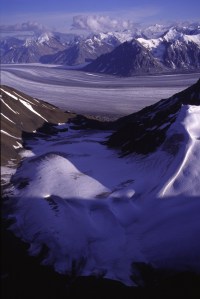
On a shorter time scale, two researchers from Canada and Sweden surveyed the impact that a century’s worth of warming would have on the world’s glaciers, which are already melting. Using temperatures derived from different climate models—and taking future carbon emissions from a mid-level projection by the Intergovernmental Panel on Climate Change—the scientists found that total glacier volume would be reduced by an average of 21% by 2100, though some areas could see as much as 75% melt away. (Download a PDF of the study here.) That would raise sea level by about a dozen centimeters, though that’s almost definitely an underestimate, as it excludes losses from Greenland and Antarctica. And of course, as the first study showed us, climate change won’t stop in the year 2100—even if we succeed in rapidly reducing carbon emissions. Once we change the climate, it will keep on changing.

It’s tough to get our head around a century—after all, back in 1900 we were just beginning to flood the atmosphere with carbon emissions, and look at what’s happened already. An entire millennium is unimaginable, yet the decisions we make as a society now will impact the sort of planet we have in the year 3000—assuming human beings are still around. Skeptics will argue that in hundred years, let alone a thousand years, we’ll be much richer and technologically more advanced, far better prepared to cut carbon emissions and deal with whatever warming will bring. Perhaps—but as these studies show, if we can reduce carbon emissions pretty soon, we’ll be dealing with the effects for hundreds and hundreds of years. Politics may not operate on climatological time, but the Earth does—and so does the species.

More on TIME and glacier melt:

The Tragedy of the Himalayas

Related Topics: Antarctica, climate science, glaciers, global warming, Himalayas, IPCC, melt, Nature, sea level rise, Climate Science
  • Latest on Ecocentric

    Alexander Demianchuk / Reuters

    Global Warming: An Exclusive Look at James Hansen’s Scary New Math

    A new analysis by the NASA climatologist for the first time ties specific weather events to human-induced climate change

    Victor Fraile / Getty Images

    By Sea, Land and Air: Hong Kong Inventor Leads Charge in War Against Pollution

    One Hong Kong engineer puts the city’s surf and turf to work toward a cleaner future

    Paul Souders

    Can Polar Bears Keep Their Heads Above Water in a Warming World?

    Polar bears are classified as marine mammals, like a seal or a walrus, which might come as a surprise given that they’re usually pictured on land. But polar bears spend a lot of their time in the waters of the Arctic, fishing or swimming among the sea ice. They may look awkward in the water, but no creature with paws is a better swimmer.

  • jdoddsgw

    This column makes no sense.
    First you are assuming that ‘More CO2 means more Warming,” per Arrhenius and the IPCC.
    CLearly this is not correct. In the Greenhouse effect you must add an energy photon to a greenhouse gas to get the warming. A simple observation of daily warming & cooling by the sun, shows that it still gets colder every night inspite of how much CO2 you add during the day. This results in the conclusion that it is the addition of added energy photons to the air that causes warming. The decrease in the number of photons at night results in the cooling. The Arrhenius finding that more CO2 means more warming is in error. IT IS NOT VALID SCIENTIFICALLY as proven every day when it cools at night.
    Reality on Earth is that there is excess CO2 and water vapor GHGs in the air. This means that the number of photons available to be absorbed is limited and continuously exceeded by the number of available GHGs. Thus any added GHGs such as CO2 just results in more added excess GHGs . It does not add to warming. There is NO extra energy photon available to cause the warming.

    On this basis the conclusions in the column are totally absurd. Or don’t you believe the reality of daily warming and cooling. IF more CO2 meant more warming, then the temperature could never go down until all the GHGs were vaporized & in use for the GHE., and all the water in the ocean would have vaporized. Unless I missed something this has not happened.
    The idea that global warming is caused by the GHG is ridiculous. For a better explanation see the paper Gravity causes Climate Change at http://www.scribd.com

  • 60south

    The tyranny of physics.

    It doesn’t care about your political ideology, celebrity politicians, radio commentators, blog posters with bad grammar, Fox News, or economic theory. It just is. Many of us would like to deny the changes we are inflicting on the earth, but it will happen anyway.

    Bloggers like jdoddsgw reveal themselves to be ignorant of physics; either that, or they are inept shills for the oil companies. They obviously don’t understand radiation budgets, climate models, or bother to recognize the colossal amount of effort scientists have devoted to studying these topics.

    Too bad ignorance isn’t painful.

    The human race will survive. It’s only a question of how miserable we will make ourselves.

  • arnoarrak

    You seem to think that you know a lot of physics. Did you know that the average lifetime of a carbon-14 atom in the air that was produced by nuclear testing in the fifties was only ten years? Similarly, using the seasonal wiggle in the CO2 curve, it can be determined that 8 percent of CO2 is absorbed by plant life every year. This works out to an average lifetime of a CO2 molecule in the air of twelve years. What happens then? These guys are talking of thousands of years and don’t have the slightest idea of the molecular dynamics of CO2. There is obviously a massive exchange with the oceans to consider. But modeling? Starting with Hansen, all the modeling predictions have disgraced themselves by being wrong but still they keep doing it. Does it not bother you that not one of these dozens of models could predict the cooling in 2008? Trenberth was complaining about it in a Climategate email. It was a La Nina cooling and that was simply not possible because they don’t even know what ENSO is. Carbon dioxide has been steadily going up for ten years, predictions have been steadily going up for ten years, but the warming predicted is missing. And what’s the excuse? “Cold winters prove that global warming is real.” It’s time to take away these toys from those modeling guys because they are costing a pretty penny to Uncle Sam and do not produce anything useful or real.

  • robertareyou1

    C/O\2/ DOSE,S NOT E: GLOBAL WARNING

    The Bright Morning Stars will restore
    the Bio-Electrode Magnesium Levels in our Atmosphere will restore by
    producing Molly Cellulite
    That life will rebuilt itself and we can maintain our planet with
    light, care, and reduce the energy required .With Seven Satellite it
    will require and the cooperation of all cities and every nations
    within range not use Public Lighting unless need.
    The start up cost is enormous, but the cost is low to preserve the
    only earth we have and give all children what is their better
    existence.

    look at the moon it.s not and elclepe,s

    Robert Steneck

    1995the norther hemisphere is risen temp do to ring of fire and
    activity and more
    ROBERT
    STENECK.
    WITH (GOD LOVE)
    (AID,S AS WELL AS HEPATITIS C )

    IT,is & (MULEFICTIONS}} (>DISEASE )//[(POST /
    =CRYOGENIC`-0}`-/'CROH=;LESION'''}}* And many OTHER
    DISEASE NOT KEEP IN CONTAINMENT OR CURE" WITH EN}}

    With the treatment two use for above with (SEROMYCIN) . as the
    toxin,s in water very do not exceed more then
    ((TWO GRAMS SODIUM NITRATE'S TOTAL INTAKE}} OR EAT BEFORE REMOVE ALL
    SALT FROM DIET FLESH AS WELL FOR CANCER PATIENTS AS WELL FOR TREATMENT
    THAT CONCEDE
    As the body finds and aborts foreign subs tents and recovers ENHANCAEIVLY
    lab test will not be culsive all lesion thay refer to as cancer breast
    cancer as well and more
    the I can name
    AND POSIBLE OVER NINE HUNDRED MILLION LIVE ; S SPARED GOD BLESS

    FEMALE NEED REQAUR THAT NEED RINSE BREST.S VALVE TO RINSE TO CLEANSES
    AS GOD INTENDED GRATE ANTIBODY'S WILL PRO SEED

    HEART MURMUR,S

    {(BISCOE TREE PRUNUS PERICA}}
    Eat one hand full of pick leaves for top of trees eat quarterly at one
    time to elasticate arteries
    for full body and give.s energy and remove pain an mobility and youth.

    {{ CURE FOR ALL, DE.COLI/S DISEASE,S]]

    MELATONIN LEG EXTRACT;” IN ARMOR ONE IN COLI,S GIVE TO ALL CANCER
    RESEARCH

    IN MEMORY OF BOBBY KENNEDY
    A GOOD MAN
    GOD BLESS THE UNITED STATE OF AMERICA

    READ PAGE 30-31 53 AND 78 JAMES.D WATSON (DNA) THE SECRET OF LIFE THANK YOU AND
    SEE DC GET,S IT [TABER,S CYCLOPEDIC MEDICAL DICTIONARY REPORT

    PAGE.S 55-57]] HIV NOT APPLICABIE [[HIVE,S]] RAIN FOR PEACE if im
    wrong concening the little body issues then I would be with all
    BIBBLE
    god gift.MCOMPASS THE PROLBAUM

  • orkneygal

    So, no reason to try to stop CO2 emissions with useless, futile, misguded and wrong-headed taxes, cap and trades schemes, etc.

    None of that will make a difference according to the models.

    Better to spend the effort on reforrestation, preservation of native habitat, cleaning up the oceans, stopping agricultural runoff into tidal plains and other useful efforts that trying to stop CO2 emissions.

  • http://leenorton.wordpress.com leenorton

    This is an excellent article. People should do their homework before commenting that CO2 doesn’t warm our planet, that man can’t change the climate, etc.

    In the early 20th century there were real science sceptics that did not believe in CO2 warming the planet. They thought the CO2, which only allows infrared radiation to heat it up in a narrow frequency band, would become saturated and ineffective as the amount of CO2 in the atmosphere increased. (This is true as Charney’s constant indicates doubling of CO2 gives us 3 degrees C increase in global temperatures. i.e. 1 doubled to 2 ppm equals 3 degrees, the same as 200 doubled to 400 ppm. This allows trace greenhouse gasses to affect the climate.) The previous scientists further argued that additional CO2 would be taken up by the ocean and plant life, that would now grow faster. In the 50′s, Dr. Revelle showed through his calculations that the ocean could not take in all the additional CO2 and that the concentration in our atmosphere had to be increasing. This was proven by Dr. Keeling in 1960, after two years of measuring the CO2 increase from Manua Loa in the Pacific. 1958 was the first year man had the ability to measure CO2 in the atmosphere.

    In the past, the sceptics were honest scientists trying to understand nature and our atmosphere. Nowadays, people giving arguments against man-made global warming by shouting out ignorant, and misleading partial facts are not sceptics, but deniers. The media is doing a poor job of checking that the sources quoted come from peer reviewed understanding of science when it comes to global warming.

blog comments powered by Disqus