



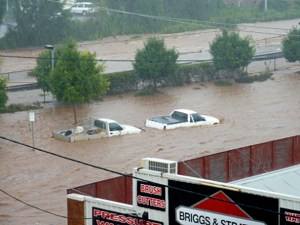
 It’s another miserable day for flood-stricken Queensland, with parts of Brisbane being evacuated after the city’s river burst its banks on Tuesday afternoon. Local reports say the Brisbane roads that haven’t been closed due to flooding are choked with fleeing residents.
Yesterday, flash floods roared through a valley nearby, crashing through the city of Toowoomba and bringing the death toll from the ongoing floods to 18, with scores more still missing. Early Tuesday morning, emergency workers plucked residents off their rooftops, and thousands were ordered to evacuate their homes and businesses that are in that water’s predicted path.
“Today is very significant, tomorrow is bad, and Thursday is going to be devastating for the residents and businesses affected,” Brisbane city mayor Campbell Newman was quoted as saying on the BBC. About 6500 properties in Australia’s third largest city are expected to be flooded.
I was surprised to read the news this morning, not just because the unfolding disaster ratcheted up so suddenly, but because of the location. I wrote a story about Toowoomba in 2007, when the Queensland town of some 90,000 was in the grip of the worst drought the region had seen in over a century. The region was literally running out of water: Water restrictions had been in place for years, farmers were on suicide watch, and the city was looking to a state-backed experiment in cloud seeding to help generate rainfall in their parched land.
Today, the picture couldn’t be more different. Downtown Toowoomba is strewn with the detritus of the flood surge — overturned cars, furniture, and debris — and residents are searching for loved ones or and mourning their dead, at least two of whom were children.
(See photos of the Queensland floods.)
These extreme swings in weather are not foreign to Australia, which has a kind of boom and bust weather cycle that gets markedly worse in La Nina events like the one that unleashed a downpour in December over a chunk of Oz territory larger than France and Germany. At current sea levels, severe floods hit an average of once in every 10 years, and extreme events hit once in a century.
According to a 2009 study released by the Australian government to assess the risk climate change poses Australia’s coastline, that rarity could soon be a thing of the past. “Climate Change Risks to Australia’s Coast” concludes that “with a mid range sea-level rise of 0.5 metres in the 21st century, events that now happen every 10 years would happen about every 10 days in 2100. The current 1-in-100 year event could occur several times a year.”
The report defines a 1 in 100 year event, used as a benchmark for Australia emergency planning, as equivalent to the kind of floods that swept New South Wales in 2007, in which thousands were forced to evacuate and insured losses exceeded $1.3 billion. It’s safe to say that if we’re not there already in Queensland, we will be, considering the agriculture and the $30 billion coal sector are at a standstill, thousands have already evacuated, and the floodwaters continue to encroach on Brisbane as I write. The projected production losses from the Queensland coal sector, in which over half the mines have declared force majeure on coal contracts, could reach over $1.25 billion, with U.S. companies already scrambling to fill the gap in supply.
All of which leaves the Queensland authorities, when the clouds do eventually part, with some major re-thinking to do about how it should spend the next 99 years — if there is that much time — shoring up against the next disaster.
(Read Bryan’s post about the floods and the disaster gap.)