
What is killing the pacific salmon?

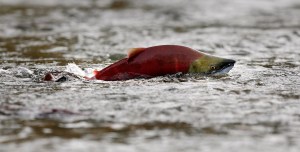
A sockeye salmon
A sockeye salmon
Andy Clark/Reuters

The great sockeye salmon run from the Pacific Ocean to Canada’s Fraser River was for decades an example of nature’s fruitful bounty. Some 60 million fish returned annually to spawn. But starting in the 1990s, the sockeye’s productivity declined precipitously—and in 2009 only 1 million fish returned to the run.

That led the Prime Minister of Canada to launch a judicial inquiry into the salmon collapse—wild salmon is worth over $1 billion to the economy of British Columbia.

As head of the inquiry, British Columbia Supreme Court Justice Bruce Cohen found a wealth of scientific data on the sockeye salmon; in fact, his office received so much information—more than 30 reports and over 700 recommendations—that it recently had to call for an adjournment to digest the huge volume of material. But despite all that research, scientists still don’t have a grasp as to what caused the decline.

(See TIME’s list of the best photos of the natural world from 2002).

That might be changing. Writing in the latest edition of the journal Science, Canadian biologists say that they have identified a key genetic signature among fish that die on their way upriver that indicates they are suffering from metabolic and immune-related stress. What’s more, this signature appears in the fish before they enter the river for the journey. Although the research doesn’t reveal the cause of this stress, the scientists speculate that a viral infection may be responsible.

Co-author Scott Hinch at the University of B.C. says that the infection probably starts at sea, before the fish make their run upriver, a phenomenon he describes as “dead fish swimming” in an interview with the Vancouver Sun today. He said the virus may be associated with leukemia and lymphoma.

“There is no doubt there is some form of pathogen involved,” Hinch said.

Climate change may be exacerbating the problem, too. Seven of the past 10 summers were the warmest on record for the Fraser River, and biotelemetry revealed high losses of salmon in regions of the river with elevated temperatures. Previous studies on salmon migration has shown that warmer water reduces the delivery of oxygen to the tissues of the fish and allows more rapid development of infections.

(Click here to read how to save the world’s fish.)

In recent years Canada has imposed substantial reductions on fishery harvests. The strategy may be working. In 2010, scientists recorded an estimated run of 30 million salmon—the largest run of the century. Even so, scientists warn that the 2009 run marked such a shocking decline that it’s too early to assume that the fish have guaranteed a sustainable future. To ascertain that, scientists must first get to the bottom of what caused one of nature’s great rituals—the sockeye salmon run— to so precipitously decline. This new study marks an important step in that journey of discovery.

Related Topics: Bruce Cohen, Fraser River, Salmon, Science Journal, Sockeye Salmon, Endangered Species, Environmentalism, Oceans
  • Latest on Ecocentric

    Don Farrall

    Falldown: Radioactive Fallout From Fukushima Posed Little Threat to the U.S.

    Nearly a year after the Japanese tsunami and subsequent meltdown at the Fukushima nuclear plant, the good news is that the risk from radiation doesn’t seem to be as high as many initially feared. Take the Pacific Ocean, for example, where most of the radioactive fallout from the plant eventually ended up. Nicholas Fisher, a marine science professor at New York’s Stony Brook University, took samples of the seawater three months after the accident. He found levels of radiation that were elevated, but still just a fraction of the amount of radioactivity sea life is exposed to from naturally occurring potassium in seawater.

    Nick M Do

    Gasbag: Why No President Can Bring Us $2 Gasoline

    It’s Presidents’ Day as I write this, so if you were lucky enough to have the day off, give some thanks to Washington, Lincoln and all the other chief executives — even stinkers like James Buchanan and Andrew Johnson. Of course in modern American politics, every day is really Presidents’ Day — so central is the occupant of the White House to the perceived state of the nation. Good news or bad news, foreign or domestic, the President gets the credit — and he gets the blame, whether he actually deserves either.

    Bloomberg via Getty Images

    Pipeline Politics: Are the Oil Sands “Game Over” for the Climate? One Study Says No

    There are no shortage of reasons why the Keystone XL pipeline has become such a hot button issue for environmentalists. Many worry about the risks the project could pose to the Ogallala aquifer in Nebraska, where the pipeline was originally designed to pass. Indeed, when President Obama rejected Keystone XL in January, his stated concern was the potential threat to local water supplies.

  • http://oldswab.wordpress.com oldswab

    So, the run went from 60M in the eighties, to 1M in 2009, to 30M in 2010? Was that 30M sockeye, or total Canadian salmon? Are fluxes like that normal?

    I wish these sorts of articles were written clearly. C’est incredible.

  • http://8020vision.com jaykimball

    Stunning that the catch went from 60 to 1 million!

    I live on an island in the Pacific Northwest, and we spawn over a million King Salmon each year. They go out deep into the Pacific in a 4 year cycle, then return.

    The local Orca whales feast on the salmon, and marine biologists are noticing that the whales are getting serious tumors and other cancerous growths.

    The thinking is that they are getting a lot of the toxic emissions from China – coal burning power plants, mercury, heavy metals, etc. – that blow out in to the Pacific and are deposited by rains, into the ocean. The toxins are stored in the salmons fat, and when they return to the Northwest, move up the food chain, as the salmon are consumed by predators.

    Orcas are heavy eaters of salmon, so the concentration of the toxins is large.

    It is a complex world, and beyond our ability to fathom just how deep and wide we are effecting the planet through our industrial powered lifestyles.

    Jay Kimball
    http://8020vision.com

  • mlwwilson

    we have the La Nina & the North Atlantic Oscilliation in effect which is making the waters colder. I think this is one of the problems. With the other fish dying off in other states and countries I think it can be hypoxia. For some reason all of this is effecting each other.

    mlw in NH

  • darkhorsewins

    Men finally getting their balls back: http://goo.gl/obiC

  • http://bunglinbee.wordpress.com bunglinbee

    G Modified Salmon have escaped from the laboratory and are whuppin’ up on the regular salmon. No, not really but if we don’t quit this GM food, it could happen. We should pay closer attention to our environment and protecting the natural species.

  • http://thestevenbrownexperience.wordpress.com thestevenbrownexperience

    It’s a shame that the pacific salmon run is steadily declining. However, it is also a shame that this article does not bring to light the impact that the aquaculture industry has on salmon fry leaving the river shortly after hatching. All along the BC coast, fish farms are placed at the mouths of rivers in order to maintain constant water flow through the open-pen cage system. However, with such small quarters, salmon inside the cages prove to be a breeding ground for louse to thrive. The heavy amounts of pesticides used in the genetically modified feed keep these sea lice from effecting the farmed salmon, however the wild salmon passing by are unable to defend themselves from these un-naturally timed parasites. These wild salmon are then burdened with these lice throughout their lifetime eventually causing death. I strongly urge anyone to do further research into this subject area as it is affecting not only the salmon, but an entire industry and economy.

blog comments powered by Disqus