
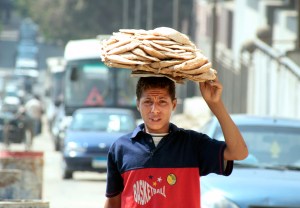
Bread Is Life: Food and Protest in Egypt

It’s impossible to say what exactly the next few days will bring in Egypt, both for the protestors and for the government. It seems clear that the days of the administration of President Hosni Murbarak  — at least in its present incarnation — are numbered, and tens of thousands of demonstrators on  the streets of Egypt’s cities will very likely remain there until some epochal shift has come to pass.

Whoever ends up seeing the nation through to its next phase would do well to keep bread high on their list of priorities.

In the last few days, soaring food prices have been cited as one of the proverbial straws that led Egyptians to take to the streets in frustration over Murbarak’s 30-year rule. It wouldn’t be the first time that food has been a catalyst for social upheaval in the northern African nation. In 1977, what came to be known as the Egyptian Bread Riots broke out after the state ended its subsidies of basic food staples. Hundreds of thousands of poor Egyptians took to the streets; scores were killed and hundreds were injured. Thirty years later in 2007 and 2008, as food prices soared and food riots swept cities across the globe, panic over a disruption in the supply chain of flour and bread in Egypt again unfolded into deadly protests.

This year, food prices are also reaching worrying highs. Global wheat prices are at an all-time high, and other grains and meat prices were up over 20% by the end of 2010. Though some 40% of Egypt’s 80 million residents live in poverty, high food prices don’t have the same impact in Egypt that they might have in other vulnerable countries. The nation has a huge subsidy program that, when its working right, helps protect its poorest citizens from inflated food prices. Two years ago, when food prices were soaring and riots broke out, there technically was no food shortage, but the high prices of commodities – and bad management of the private and government supply chain – led to disruptions in the supply of subsidized grain, so many couldn’t afford to eat.

What’s troubling today, says FAO senior economist Abdolreza Abbassian, is the prospect of a similar disruption in any potential power vacuum that could take place in the coming weeks, months, or years ahead. In 2007 and 2008, the protests happened “when authorities were still in full control of the country,” says Abbassian. “When there was no major threat to the establishment, the country found itself in the midst of a big problem…Today, what can we say? This is what worries me.”

In Egypt, the Arabic word for bread — “aish” — is also the world for life. Egyptians are the world’s largest consumers of bread and Egypt is the world’s largest wheat importer. The government buys most of the wheat it needs each year from wheat exporters like the U.S., Canada and Australia. Because it’s so early in the year, millions of tons of purchased wheat for 2011 are still en route to the country. The current state of disorder could pose problems for the wheat supply to get in. “If the import doesn’t materialize, I don’t think Egypt has enough supplies domestically to meet the demands of the population,” says Abbassian. “There is a sense of insecurity in the city… The last thing  you want is the subsidy to start failing.”

If that happens, the demonstrations that have been chiefly political in nature may very well take a sharp and potentially dangerous turn, and the government could have a new kind of emergency on its hands. “Whoever takes over knows that meeting the food demand of the 80 million will be the highest priority,” says Abbassian. “I don’t think there could be any bigger priority than this.”

Related Topics: Egypt, food prices, protests, wheat, Food, Politics
  • Latest on Ecocentric

    Don Farrall

    Falldown: Radioactive Fallout From Fukushima Posed Little Threat to the U.S.

    Nearly a year after the Japanese tsunami and subsequent meltdown at the Fukushima nuclear plant, the good news is that the risk from radiation doesn’t seem to be as high as many initially feared. Take the Pacific Ocean, for example, where most of the radioactive fallout from the plant eventually ended up. Nicholas Fisher, a marine science professor at New York’s Stony Brook University, took samples of the seawater three months after the accident. He found levels of radiation that were elevated, but still just a fraction of the amount of radioactivity sea life is exposed to from naturally occurring potassium in seawater.

    Nick M Do

    Gasbag: Why No President Can Bring Us $2 Gasoline

    It’s Presidents’ Day as I write this, so if you were lucky enough to have the day off, give some thanks to Washington, Lincoln and all the other chief executives — even stinkers like James Buchanan and Andrew Johnson. Of course in modern American politics, every day is really Presidents’ Day — so central is the occupant of the White House to the perceived state of the nation. Good news or bad news, foreign or domestic, the President gets the credit — and he gets the blame, whether he actually deserves either.

    Bloomberg via Getty Images

    Pipeline Politics: Are the Oil Sands “Game Over” for the Climate? One Study Says No

    There are no shortage of reasons why the Keystone XL pipeline has become such a hot button issue for environmentalists. Many worry about the risks the project could pose to the Ogallala aquifer in Nebraska, where the pipeline was originally designed to pass. Indeed, when President Obama rejected Keystone XL in January, his stated concern was the potential threat to local water supplies.

  • http://matthewashton.wordpress.com matthewashton

    The Roman Empire always understood that bread was key to the poeple’s loyalty. That and regular entertainment.

    More recently it’s been commented that every society is only three meals away from revolution. Scratch the surface of civilisation and people are usually quite willing to challenge the system if they feel that they’re being oppressed in some tangible way.

    The big question is, will a democratic government be able to do any better. If the Egyptian’s do hold elections to get a new government they’ll be under immense pressure to turn the economic situation around a s quickly as possible. If they fail to do that then the citizens could turn on them as well just as quickly.

  • http://vaengineer.wordpress.com vaengineer

    Egypt’s problem is a basic one, and we will see more of it in other countries as time goes on. Basically, its population has outgrown its capacity to produce food. Egypt now imports about 40% of its food. When a country must import much of its food it is at the mercy of supply and demand. Its population is compounding at 2% growth per year and the pressure on food will continue to mount. This is a tough problem for any government-dictatorship or democracy-to solve.

  • vasumurti

    “Global hunger could be directly attributed to meat-eating.”

    —Chrissie Hynde

    Half the world’s population does not receive an adequate amount of food to eat. Ten to twenty million die annually of hunger and its effects. The Institute for Food and Development Policy reports that, “Forty thousand children starve to death on this planet every day,” or one child every two seconds.

    The livestock population of the United States today consumes enough grain and soybeans to feed over five times the entire human population of the country.

    We feed these animals over 80% of the corn we grow, and over 95% of the oats. Less than half the harvested agricultural acreage in the United States is used to grow food for people. Most of it is used to grow livestock feed.

    Ronald J. Sider of Evangelicals for Social Action, in his 1977 book, Rich Christians in an Age of Hunger, pointed out that 220 million Americans were eating enough food (largely because of the high consumption of grain-fed livestock) to feed over one billion people in the poorer countries.

    The world’s cattle alone, not to mention pigs and chickens, consume a quantity of food equal to the caloric needs of 8.7 billion people. It takes 16 pounds of grain to produce one pound of beef.

    According to Department of Agriculture statistics, one acre of land can grow 20,000 pounds of potatoes. That same acre of land, if used to grow cattlefeed, can produce less than 165 pounds of beef.

    In his book, The Hungry Planet, Georg Bergstrom points out that protein-starved underdeveloped nations export more protein to wealthy nations than they receive. He calls this “the protein swindle.”

    Ninety percent of the world’s fish meal catch, for example, is exported to rich countries. One-third of Africa’s peanut crop winds up in the stomachs of European livestock. Half the world’s cereal crop is fed to livestock and the United States annually imports one million tons of vegetable protein from Third World nations–just to feed its farm animals.

    Bergstrom writes: “Sometimes one wonders how many Americans and Western Europeans have grasped the fact that quite a few of their beef steaks, quarts of milk, dozens of eggs, and hundreds of broilers are the result, not of their agriculture, but of the approximately two million metric tons of protein, mostly of high quality, which astute Western businessmen channel away from the needy and hungry.”

    Jeremy Rifkin, author of a dozen influential books and President of the Foundation on Economic Trends, writes in his 1992 bestseller Beyond Beef:

    “Cattle and other livestock are devouring much of the grain produced on the planet. It need be emphasized that this is a new phenomenon, unlike anything ever experienced before.

    “Contrary to popular belief, the poor are getting poorer each year…Increased poverty has meant increased malnutrition. On the African continent, nearly one in every four human beings is malnourished. In Latin America, nearly one out of every seven people goes to bed hungry each night. In Asia and the Pacific, 28 percent of the people border on starvation, experiencing the gnawing pain of a perpetual hunger.”

    “In the Near East, one in ten people is underfed. Chronic hunger now affects upwards of 1.3 billion people, according to the world Health Organization–a statistic all the more striking in a world where one third of all the grain produced is being fed to cattle and other livestock. Never before in human history has such a large percentage of our species–nearly 25 percent–been malnourished.

    “The transition of world agriculture from food grain to feed grains represents an…evil whose consequences may be far greater and longer lasting than any past examples of violence inflicted by men against their fellow human beings.”

    In the 1970s, the United Nations Secretary General said that the food consumption of the rich countries is the key cause of hunger around the world. The United Nations has recommended that the wealthy nations cut down on their meat consumption.

    The Worldwatch Institute has released a remarkable report entitled Taking Stock: Animal Farming and the Environment, which lists nation after nation where food deprivation has followed the switch from a grain-based diet to a meat-based one.

    Most of the nations that now import grain from the United States were once self-sufficient in grain. The main reason they aren’t is the rise in meat production and consumption.

    In Taiwan, for example, per capita consumption of meat and eggs increased 600 percent from 1950 to 1990. With this change, vastly increased amounts of grain have gone to livestock, raising the annual per capita grain use in the country from 375 pounds to 858 pounds. In 1950, Taiwan was a grain exporter; in 1990 the nation imported, mostly for feed, 74 percent of the grain it used.

    In mainland China, the situation is similar. Increased meat consumption has meant less grain available to feed people. Since 1978, meat consumption has more than doubled, to twenty-four kilograms. The share of Chinese grain fed to livestock rose from 7 percent in 1960 to 20 percent in 1990.

    Over half Of Latin America’s beef production is exported, and the rest is too expensive for any but the wealthy to purchase. From 1960 to 1980 beef exports from El Salvador increases over sixfold. Meanwhile, increasing numbers of small farmers lost their livelihood and were pushed off their land. Today, 72 percent of all Salvadoran infants are underfed.

    In Brazil, major portions of the Amazon tropical rain forests have been destroyed so that wealthy multinational corporations can produce beef for the wealthy.

    Corporations such as Volkswagen, Nestle, Mitsubishi, Liquigas, King Ranch, and Swift-Eckrich have bulldozed and burned literally hundreds of millions of acres, replacing the world’s oldest and richest ecosystems, home to two million or more species of plant and animal life with a single crop–pasture grass for cattle.

    And here, the beef produced has not gone to feed hungry Brazilians; it has been primarily exported to Western Europe, the Middle East, and North America. In 1987, the United States imported three hundred million pounds of meat from countries in Central and South America.

    With the help of international lending institutions, Brazil has mounted an enormous effort to increase agricultural production, but this has been primarily meat-oriented production and for export.

    In the late ’60s, soybeans were almost nonexistent or Brazil. Today, this crop is the nation’s number one export–but almost all of it goes to feed Japanese and European livestock. Twenty five years ago, one third of the Brazilian population suffered from malnutrition. Today, the figure has risen to two thirds.

    Oxfam, the international charity, reports that in Brazil huge cattle ranches take up some of the most fertile soil in the whole country, yet 60 percent of Brazilians are malnourished.

    Oxfam estimates that in Mexico, 80 percent of the children in rural areas are undernourished, yet the livestock are fed more grain than the human population eats!

    The livestock are exported of course, to satisfy the developed nations’ craving for cheap hamburgers.

    In Guatemala, 75 percent of the children under five years of age are undernourished. Yet, every year Guatemala exports 40 million pounds of meat to the United States. It borders on the criminal!

    In Costa Rica, beef production quadrupled between 1960 and 1980, but almost all this beef is exported to the United States, and what does stay in the country is eaten by a tiny minority.

    Though more and more Costa Rican land is being turned over to meat production, the population is not eating more meat for the change. The average family in Costa Rica eats less meat than the average American housecat.

    Throughout Latin America, land availability is a prominent social issue. Revolutionaries as well as reform-minded moderates have made land reform a major issue. Yet in many Latin American countries, forests are being leveled in order to create pastures for cattle grazing land.

    In a region where land availability is a central social issue, existing land is being gobbled up by livestock agriculture. The resulting social tensions have resulted in civil wars, repression and violence.

    Hunger is really a social disease caused by the unjust, inefficient and wasteful control of food. Our food security is not being threatened by the prolific, hungry masses, but by elites that profit by the concentration and internationalization of control of food resources.

    In country after country the pattern is repeated. Livestock industries are consuming feed to such an extent that now almost all Third World nations must import grain.

    Seventy-five percent of Third World imports of corn, barley, sorghum, and oats are fed to animals, not to people. In country after country, the demand for meat among the rich is squeezing out staple production for the poor.

    The same trend can be found in the Middle East and North Africa–increases in grain-fed livestock require more imported feed. In the early ’70s, Egypt was self-sufficient in grain.

    Then, livestock ate only 10 percent of the nation’s grain. Today, livestock consume 36 percent of Egypt’s grain. As a result, Egypt must now import eight million tons of grain every year.

    In the late ’60s , Syria was a barley exporter. But in the intervening years, livestock has consumed increasing amounts of the country’s grain. Now, despite a phenomenal 1,000 percent increase in the land area devoted to producing barley, Syria must import the cereal.

    According to Buckminster Fuller, there are enough resources at present to feed, clothe, house and educate every human being on the planet at American middle class standards.

    The Institute for Food and Development Policy has shown that there is no country in the world in which the people cannot feed themselves from their own resources.

    Moreover, there is no correlation between land density and hunger. China has twice as many people per cultivated acre as India, yet less of a hunger problem. Bangladesh has just one-half the people per cultivated acre that Taiwan has, yet Taiwan has no starvation, while Bangladesh has one of the highest rates in the world.

    The most densely populated countries in the world today are not India and Bangladesh, but Holland and Japan.

    Many of us believe that hunger exists because there’s not enough food to go around. But as Frances Moore Lappe’ and her anti-hunger organization Food First! have shown, the real cause of hunger is a scarcity of justice, not a scarcity of food.

  • gordonr1

    Too long to read, sorry.

  • http://dj6ual.wordpress.com dj6ual

    Now that the protests are hitting there peak I think things are sure to move quickly. Soon this scenario will play out here on the streets of America. There are forces at work trying to usher in the last days, Revelations, the Apocalypse… call it the Illuminati, the New World Order, or whatever you want… it is coming… hell it is already here! Step by step we will all watch as the reality around us unravels, that is unless we are lucky enough to be awake. Those of us who have our eyes open can avoid the initial blows but it will take a strong Army to fight the wars that are ahead. Be prepared, be safe, and awaken those around you, they will be next to you in the battle.

    Prediction: GAS $18.00 a gallon by year’s end

    Egyptian Unrest – Connecting the Dots
    http://dj6ual.viviti.com/entries/news/the-tear-gas-smoke-bombs-used-against-egyptian-protesters-were-also-used-at-g-20

  • http://dj6ual.wordpress.com dj6ual

    Awww… come on, you can do it! (lol!) At least do me a favor and stock up on some food for your own family so when this happens here you won’t be in trouble. Blessings!

    ~DJ6ual
    http://dj6ual.viviti.com

  • http://8020vision.com jaykimball

    One of the explanations for why Rome fell had to do with food shortages.

    There is a that says:

    “Civilization and anarchy are only seven meals apart.”

    Julian Cribb wrote an excellent book on food trends and what we can do about it. See:

    http://8020vision.com/2010/08/26/recommended-reading-the-coming-famine/

    The challenge is heightened in poor nations where food can consume over 60% of a days wages. In that case, what may appear as a small increase in the price of wheat or rice, becomes a painful thing for the poor.

    Jay Kimball
    8020 Vision

blog comments powered by Disqus