
Forests Vs. Food?

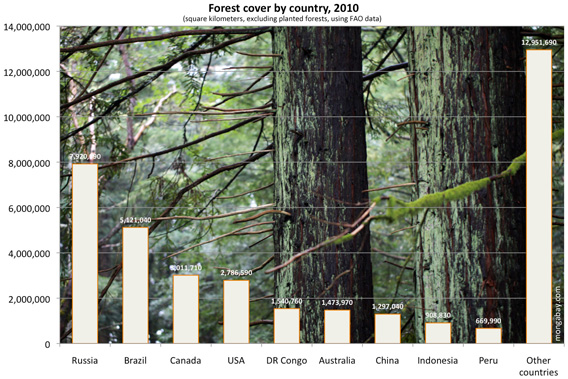
The story of the world’s forests is usually a depressing one. Tropical rain forests are under pressure in South America, Asia and Africa, threatening habitat for countless species and adding billions of tons of carbon dioxide to the atmosphere every year. But while the headlines can be scary, the reality is that the world may be close to turning a corner on deforestation—a change that could pay off for wildlife and the climate. According to the U.N. Food and Agriculture Organization (FAO), there were 4.032 billion hectares of forest standing in the world in 2010. That’s down slightly from 2000, but the good news is that the rate of overall forest loss has slowed considerably, dropping from 8.3 million hectares lost a year in the 1990s to 5.2 million hectares a year, thanks in part to significant reforestation taking place throughout much of Asia. A graphic from the forest site Mongabay.com shows where the trees are:
2011 could be the year the world finally stops losing the fight against deforestation. On February 2 the U.N. launched the International Year of Forests, beginning a series of events meant to raise awareness about the vital importance of forests and generate support for sustainable forestry practices. At December’s U.N. climate summit in the Mexican city of Cancun, governments took the first concrete steps towards creating a system for avoided deforestation, or REDD (Reduced Emissions from Deforestation and forest Degradation), which would allow companies and countries to claim carbon credits for maintaining trees. But at the same time, record high food prices could reverse all of that progress, if farmers around the world choose to clear forest to make room for more crops. “In my view, 2011 is going to be the critical year,” says Frances Seymour, the director-general of the Center for International Forestry Research. “This is the year we’ll find out whether we’ll be successful or not.”

First the good news. Most environmentalists believe that REDD offers the best way to generate the billions in finding needed to finally halt deforestation in the tropics, where forests and jungles support a wealth of biodiversity. Right now, a forest only has monetary value when it’s been cleared for farming and sold for logging. Simple economic pressures explain why we’ve already lost so much forest in the world’s poorest countries. But REDD changes that equation. By measuring and creating a market for the billions of tons of carbon contained within trees, REDD could make it economically worthwhile to keep forests standings, by letting tropical countries essentially sell the carbon but keep the trees. Greed could save forests, instead of destroying them.

But for REDD to ever work at scale beyond a few small pilot projects, it would need to be tied to an international climate deal. For most of 2010, in the wake of the Copenhagen summit’s collapse and Congress’s failure to pass a carbon cap, that seemed impossible. Because a carbon market is needed support avoided deforestation, no climate deal, no REDD. Yet at the end of 2010 diplomats in Cancun managed to pull together the beginnings of a global climate agreement that crucially included a framework for REDD funding. That success has paved the way for funders like the Norwegian government, which has spent hundreds of millions of dollars to begin setting up REDD pilot projects in Brazil and most recently Indonesia, which has long suffered some of the worst deforestation in the world. At the UN Forest Forum in New York last week, Rwanda even pledged to restore its degraded landscapes from border-to-border—with the help of REDD funding. “If REDD can really get going in Indonesia, that could be a game changer,” says Seymour.

Still, all this progress could be lost if forests end up pitted against food. According to the FAO, global food prices in February were higher than they have even been before—breaking a record that was only set in January. With demand from the developing world—especially for meat, which requires significant amounts of grain—likely to keep growing, and bad weather in major farming nations keeping yields down, food prices aren’t likely to fall any time soon. At the same time, the decades of steady improvement that has allowed farmers to get more food out of ever acre has plateaued. If the world is going to get more food, it’s going to need to farm more land—and that’s often when forests start getting clear cut. “We’re looking at a perfect storm,” says Seymour. “Farming could be a major driver in forest loss.”

Deforestation isn’t an automatic consequence of high food prices though. Instead of cutting down virgin forest, farmers can look to expand farming to degraded land. Over the longer term, better investment in agricultural research—which has lagged in recent years—can lead to better yields and higher efficiency, reducing the need for more land. And agroforestry can actually combine trees and farming, to the benefit of both. In Africa a growing number of farmers are actually intercropping trees with their farmland, which can cheaply boost nutrients in their soil—certain species of trees actually fix nitrogen, reducing the need for fertilizer—and provide a ready supply of firewood. “Everyone has something to gain from this,” says Dennis Garrity, the director-general of the Nairobi-based World Agroforestry Centre. “People just have to realize this can be done.” That’s the sort of creative thinking that will be needed to make 2011 the year deforestation really ends.

Related Topics: Africa, agroforestry, climate change, deforestation, food, forests, REDD, Forests
  • Latest on Ecocentric

    Alexander Demianchuk / Reuters

    Global Warming: An Exclusive Look at James Hansen’s Scary New Math

    A new analysis by the NASA climatologist for the first time ties specific weather events to human-induced climate change

    Victor Fraile / Getty Images

    By Sea, Land and Air: Hong Kong Inventor Leads Charge in War Against Pollution

    One Hong Kong engineer puts the city’s surf and turf to work toward a cleaner future

    Paul Souders

    Can Polar Bears Keep Their Heads Above Water in a Warming World?

    Polar bears are classified as marine mammals, like a seal or a walrus, which might come as a surprise given that they’re usually pictured on land. But polar bears spend a lot of their time in the waters of the Arctic, fishing or swimming among the sea ice. They may look awkward in the water, but no creature with paws is a better swimmer.

  • vasumurti

    Veganism Is Direct Action:

    “A diet that can lead to heart attacks, cancer, and numerous other diseases cannot be a natural diet,” writes Keith Akers in A Vegetarian Sourcebook. “A diet that pillages our resources of land, water, forests, and energy cannot be a natural diet. A diet that causes the unnecessary suffering and death of billions of animals each year cannot be a natural diet.”

    I understand there are conservative Christians who fear vegetarianism…which is kind of like being afraid of nonsmoking, nondrinking, or recycling. Ronald J. Sider of Evangelicals for Social Action, in his 1977 book, Rich Christians in an Age of Hunger, pointed out that 220 million Americans were eating enough food (largely because of the high consumption of grain fed to livestock) to feed over one billion people in the poorer countries.

    A pamphlet put out by Compassion Over Killing says raising animals for food is one of the leading causes of both pollution and resource depletion today. According to a recent United Nations report, Livestock’s Long Shadow, raising chickens, turkeys, pigs, and other animals for food causes more greenhouse gas emissions than all the cars, trucks and other forms of transportation combined.

    Researchers from the University of Chicago similarly concluded that a vegetarian diet is the most energy efficient, and the average American does more to reduce global warming emissions by not eating animal products than by switching to a hybrid car.

    “Livestock are one of the most significant contributors to today’s most serious environmental problems. Urgent action is required to remedy the situation.”

    —Union Nations’ Food and Agriculture Association

    Nearly 75% of the grain grown and 50% of the water consumed in the U.S. are used by the meat industry. (Audubon Society)

    Over 260 million acres of U.S. forest have been cleared to grow grain for livestock. (Greenpeace)

    It takes nearly one gallon of fossil fuel and 5,200 gallons of water to produce just one pound of conventionally fed beef. (Mother Jones)

    Farmed animals produce an estimated 1.4 billion tons of fecal waste each year in the U.S. Much of this untreated waste pollutes the land and water.

    The following points and facts are excerpted from Please Don’t Eat the Animals (2007) by the mother-daughter writing team of Jennifer Horsman and Jaime Flowers:

    “A reduction in beef and other meat consumption is the most potent single act you can take to halt the destruction of our environment and preserve our natural resources. Our choices do matter: What’s healthiest for each of us personally is also healthiest for the life support system of our precious, but wounded planet.”

    —John Robbins, author, Diet for a New America, and President, EarthSave Foundation

    One study puts animal waste in the United States to between 2.4 trillion to 3.9 trillion pounds per year. The United states produces 15,000 pounds of manure per person. This is 130 times the amount of waste produced by the entire human population of the United States.

    A 1,000-cow dairy can produce approximately 120,000 pounds of waste per day. This is the functional equivalent of the amount of sanitary waste produced by a city of 20,000 people.

    A 20,000-chicken factory produces about 2.4 million pounds of manure a year. Poultry factories are one of the fastest growing industries throughout Asia.

    One pig excretes nearly three gallons of waste per day, or 2.5 times the average human’s daily total. One hog farm with 50,000 pigs in France produces more waste than the entire city of Los Angeles, and some pig farms are much larger.

    Factory farm pollution is the primary source of damage to coastal waters in North and South America, Europe, and Asia. Scientists report that over sixty percent of the coastal waters in the United States are moderately to severely degraded from factory farm nutrient pollution. This pollution creates oxygen-depleted dead zones, which are huge areas of ocean devoid of aquatic life.

    Meat production causes deforestation, which then contributes to global warming. Trees convert carbon dioxide into oxygen, and the destruction of forests around the globe to make room for grazing cattle furthers the greenhouse effect. The Food and Agricultural Organization of the United Nations reports that the annual rate of tropical deforestation has increased from 9 million hectares in 1980 to 16.8 million hectares in 1990, and unfortunately, this destruction has accelerated since then. By 1994, a staggering 200 million hectares of rainforest had been destroyed in South America just for cattle.

    “The impact of countless hooves and mouths over the years has done more to alter the type of vegetation and land forms of the West than all the water projects, strip mines, power plants, freeways, and sub-division developments combined.”

    —Philip Fradkin, in Audubon, National Audubon Society, New York

    Agricultural meat production generates air pollution. As manure decomposes, it releases over 400 volatile organic compounds, many of which are extremely harmful to human health. Nitrogen, a major by-product of animal wastes, changes to ammonia as it escapes into the air, and this is a major source of acid rain. Worldwide, livestock produce over 30 million tons of ammonia. Hydrogen sulfide, another chemical released from animal waste, can cause irreversible neurological damage, even at low levels.

    The World Conservation Union lists over 1,000 different fish species that are threatened or endangered. According to the United Nations Food and Agriculture Organization (FAO) estimate, over 60 percent of the world’s fish species are either fully exploited or depleted. Commercial fish populations of cod, hake, haddock, and flounder have fallen by as much as 95 percent in the north Atlantic.

    The United States and Europe lose several billion tons of topsoil each year from cropland and grazing land, and 84 percent of this erosion is caused by livestock agriculture. While this soil is theoretically a renewable resource, we are losing soil at a much faster rate than we are able to replace it. It takes 100 to 500 years to produce one inch of topsoil, but due to livestock grazing and feeding, farming areas can lose up to six inches of topsoil a year.

    Livestock production affects a startling 70 to 85 percent of the land area of the United States, United Kingdom, and the European Union. That includes the public and private rangeland used for grazing, as well as the land used to produce the crops that feed the animals. By comparison, urbanization only affects 3 percent of the United States land area, slightly larger for the European Union and the United Kingdom. Meat production consumes the world’s land resources.

    Half of all fresh water worldwide is used for thirsty livestock. Producing eight ounces of beef requires an unimaginable 25,000 liters of water, or the water necessary for one pound of steak equals the water consumption of the average household for a year.

    The United States government spends $10 million each year to kill an estimated 100,000 wild animals, including coyotes, foxes, bobcats, badgers, bears, and mountain lions just to placate ranchers who don’t want these animals killing their livestock. The cost far outweighs the damage to livestock that these predators cause.

    The Worldwatch Institute estimates one pound of steak from a steer raised in a feedlot costs: five pounds of grain, a whopping 2,500 gallons of water, the energy equivalent of a gallon of gasoline, and about 34 pounds of topsoil.

    Thirty-three percent of our nation’s raw materials and fossil fuels go into livestock destined for slaughter. In a vegan economy, only two percent of our resources will go to the production of food.

    “It seems disingenuous for the intellectual elite of the first world to dwell on the subject of too many babies being born in the second- and third-world nations while virtually ignoring the overpopulation of cattle and the realities of a food chain that robs the poor of sustenance to feed the rich a steady diet of grain-fed meat.”

    —Jeremy Rifkin, pro-life AND pro-animal author, Beyond Beef: The Rise and Fall of the Cattle Culture, and president of the Greenhouse Crisis Foundation

    According to the editors of World Watch, July/August 2004: “The human appetite for animal flesh is a driving force behind virtually every major category of environmental damage now threatening the human future–deforestization, topsoil erosion, fresh water scarcity, air and water pollution, climate change, biodiversity loss, social injustice, the destabilization of communities and the spread of disease.”

    Brother David Steindl-Rast, a Benedictine monk, similarly says in the February 1995 issue of Harmony: Voices for a Just Future (a peace and justice publication on the relgious Left): “…the survival of our planet depends on our sense of belonging–to all other humans, to dolphins caught in dragnets to pigs and chickens and calves raised in animal concentration camps, to redwoods and rainforests, to kelp beds in our oceans, and to the ozone layer.”

    Les Brown of the Overseas Development Council calculates that if Americans reduced their meat consumption by only ten percent per year, it would free at least twelve million tons of grain for human consumption–or enough to feed sixty million people.

    The number of animals killed for food in the United States is nearly 75 times larger than the number of animals killed in laboratories, 30 times larger than the number killed by hunters and trappers, and 500 times larger than the number of animals killed in animal pounds.

    People for the Ethical Treatment of Animals (PETA) is challenging those who think they can still be “meat-eating environmentalists” to go veg, if they really care about the planet.

    peta2 is now the largest youth movement of any social change organization in the world.

    peta2 has 267,000 friends on MySpace and 91,000 Facebook fans.

    A few years ago, PETA was the top-ranked charity when a poll asked teenagers what nonprofit group they would most want to work for. PETA won by more than a 2 to 1 margin over the second place finisher, The American Red Cross, with more votes than the Red Cross and Habitat for Humanity combined.

    “If anyone wants to save the planet,” says Paul McCartney in a PETA interview, “all they have to do is stop eating meat. That’s the single most important thing you could do. It’s staggering when you think about it. Vegetarianism takes care of so many things in one shot: ecology, famine, cruelty. Let’s do it! Linda was right. Going veggie is the single best idea for the new century.”

  • http://vaengineer.wordpress.com vaengineer

    What a sad sign that we call it ‘good news’ when the rate of overall forest loss drops from 8.3 million hectares lost a year in the 1990s to 5.2 million hectares a year now. Great!we’re only losing 5.2 million hectares a year!

    Maybe we’re just running out of forest to lose.

  • vasumurti

    Author John Robbins provides these points and facts in his Pulitzer Prize nominated Diet for a New America (1987):

    Half the water consumed in the U.S. irrigates land growing feed and fodder for livestock. Huge amounts of water wash away their excrement. U.S. livestock produce twenty times as much excrement as the entire human population, creating sewage which is ten to several hundred times as concentrated as raw domestic sewage.

    Animal wastes cause thrice as much water pollution than does the U.S. human population; the meat industry causes thrice as much harmful organic water pollution than the rest of the nation’s industries combined.

    Meat producers, the number one industrial polluters in our nation, contribute to half the water pollution in the United States. The water that goes into a 1,000 lb. steer could float a destroyer.

    It takes 25 gallons of water to produce a pound of wheat, but 2,500 gallons to produce a pound of meat. If these costs weren’t subsidized by the American taxpayers, the cheapest hamburger meat would be $35 per pound!

    Subsidizing the California meat industry costs taxpayers $24 billion annually. Livestock producers are California’s biggest consumers of water. Every tax dollar the state doles out to livestock producers costs taxpayers over seven dollars in lost wages, higher living costs and reduced business income. Seventeen western states have enough water supplies to support economies and populations twice as large as the present.

    Overgrazing of cattle leads to topsoil erosion, turning once-arable land into desert. We lose four million acres of topsoil each year and 85 percent of this loss is directly caused by raising livestock.

    To replace the soil we’ve lost, we’re destroying our forests. Since 1967, the rate of deforestation in the U.S. has been one acre every five seconds. For each acre cleared in urbanization, seven are cleared for grazing or growing livestock feed.

    One-third of all raw materials in the U.S. are consumed by the livestock industry and it takes thrice as much fossil fuel energy to produce meat than it does to produce plant foods.

    A report on the energy crisis in Scientific American warned: “The trends in meat consumption and energy consumption are on a collision course.”

    “All Things Are Connected,” the concluding chapter to John Robbins’ Pulitzer Prize nominated Diet for a New America (1987), begins with a quote from (reincarnationist) Christian mystic Edgar Cayce:

    “Destiny, or karma, depends upon what the soul has done about what it has become aware of.”

    John Robbins writes:

    “At the present time, when most of us sit down to eat, we aren’t very aware of how our food choices affect the world. We don’t realize that in every Big Mac there is a piece of the tropical rainforests, and with every billion burgers sold another hundred species become extinct.

    “We don’t realize that in the sizzle of our steaks there is the suffering of animals, the mining of our topsoil, the slashing of our forests, the harming of our economy, and the eroding of our health. We don’t hear in the sizzle the cry of the hungry millions who might otherwise be fed.

    “We don’t see the toxic poisons (pesticides) accumulating in the food chains, poisoning our children and our earth for generations to come.

    “But once we become aware of the impact of our food choices, we can never really forget. Of course, we can push it all to the back of our minds, and we may need to do this, at times, to endure the enormity of what is involved.

    “But the earth itself will remind us, as will our children, and the animals and the forests and the sky and the rivers, that we are part of this earth, and it is part of us.

    “All things are deeply connected, and so the choices we make in our daily lives have enormous influence, not only on our own health and vitality, but also on the lives of other beings, and indeed on the destiny of life on earth.

    “Thankfully, we have cause to be grateful–what’s best for us personally is also best for other forms of life, and for the life support systems on which we all depend.

    “The Indians who dwelt for countless centuries in what we now call the United States lived in harmony with the land and with nature.

    “Their societies were each unique, yet all were founded on a reverence for life that conserved nature rather than destroying it, and which lived in balance with what we today call the ecosystem.

    “To them, it was all the work of God. Every shining pine needle, every sandy shore, every mist in the dark woods, every humming insect was holy.

    “When the white man forced them to make the ultimate sacrifice and sell their land, the great Chief Seattle spoke for his people and asked one thing in return. He did not ask something for himself, nor for his tribe, nor even for the Indian people.

    “There were, of course, many things of immense importance he must have wanted at such a time. He could have asked for more blankets, horses, or food. He could have asked that the ancestral burial grounds be respected. He could have asked many things for himself or for his people.

    “But what stood above all else in importance had to do with the relationship between humans and other animals. His one request was as prophetic as it was plain:

    “I will make one condition.
    The white man must treat the beasts of this land
    as his brothers.
    For whatever happens to the beasts
    soon happens to man.
    All things are connected.”

    “Chief Seattle spoke for a people whose bond with the natural world was unimaginably profound. Yet the white man called them savages, and utterly disregarded his plea.

    “The factory farms that produce today’s meats, dairy products and eggs are living testimony to how totally we have disdained the one condition he made.

    “The white man thought Chief Seattle an ignorant savage. But he was a prophet whose wisdom and eloquence arose from living contact with Creation.

    “And his words are astoundingly similar to those of a book written long, long ago. The Bible, too, tells us the fates of humans and animals are intimately intertwined.

    “For that which befalleth the sons of men befalleth the beasts.
    Even one thing befalleth them:
    as the one dieth, so dieth the other;
    yea they have all one breath,
    so that a man hath no pre-eminence above a beast.”

    —Ecclesiastes 3:19

    “Chief Seattle did not know that centuries before a book called the Bible had spoken in words almost identical to his own. But he spoke on behalf of life itself, and the wisdom of the ages poured through him.

    “Today, when we have strayed so very far from an ethical relationship to other creatures and to the welfare of the world we share, his message remains with us as a light of immeasurable brilliance. Never before has the truth of his words been so apparent:

    “One thing we know;
    Our God is the same,
    This earth is precious to Him…
    This we know:
    The earth does not belong to man:
    Man belongs to the earth.
    This we know:
    All things are connected
    Like the blood which unites one family.
    All things are connected.
    Whatever befalls the earth
    Befalls the sons of the earth.
    Man did not weave the web of life.
    He is merely a strand in it.
    Whatever he does to the web,
    He does to himself.”

    (John Robbins received over 75,000 letters in response to Diet for a New America…the environmental crisis is a self-inflicted wound.)

  • mkassowitz

    The idea that forests and agriculture are diametrically opposed is actually antiquated. They can actually coexist and the result can be both productive and environmentally beneficial. The real problem is the short-sighted focus on food-chain industrialization. http://organicconnectmag.com/wp/2010/10/a-reinvention-of-agriculture-is-needed-to-meet-global-challenges/

  • prabhatmisra

    Here are few important suggestions to protect forests- 1. The peoples participation movements can play very important role in decarbonising the environment and in lowering carbon footprinting. One such type of peoples participation movement is ‘RED TAPE MOVEMENT’ launched by me in Etawah [U.P., India], to make aware the people about the environment and to give the message that to cut the plants is harmful to the nature and biodiversity survival, by tying red tape on the trunks of existing trees. Such types of movements can change the current society into environment friendly society; 2. One model has been developed by me is ‘GREEN VILLAGE’ model. In this model, atleast one member from every residence of the selected village do the tree plantation of atleast one tree and take care of it. In this way every residence of the village participate in the conservation of ecosystem and environment. In the future this will change into a big ‘carbon sinking zone’ and will be helpful in protecting our beautiful Earth from the detrimental effects of ‘GLOBAL WARMING’; 3. N.G.Os. can play very important role in creating awareness about GLOBAL WARMING. They are pivotal in planning and project implementation. They can initiate awareness about key issues like carbon footprinting, afforestation, forests and biodiversity conservation through peoples participation; 4. “ENVIRONMENT FRIENDLY LIFESTYLE” should be given the status of “compulsory fundamental duty” for every citizen. This minor change can bring a good change in decarbonising the environment; 5. It will be better to establish a ‘WORLD COMMISSION FOR SCIENCE and DEVELOPMENT’ to monitor and promote such discoveries which are environment friendly and have no harmful by-products. Our development should be scientifically approved and with environment friendly technologies.

    Prabhat Misra,
    http://www.facebook.com/prabhat.lovepeaceunity

  • prabhatmisra

    With the growth of population and continuous urbanization cum industrialisation, there is great pressure on forests and their survival is a challenge. Continuous increase in agriculture lands for food and fodder crops is going on. Our scientists must develop such hybrid crop varieties which are not only high yielding but must also possess the golden capabilities of high Oxygen production and high Carbon di-oxide assimilation. We must plan to develop a model of minimum land use with maximum productivity. Save Forests, Save Nature, Save Future.

    Prabhat Misra,
    http://www.facebook.com/prabhat.lovepeaceunity

blog comments powered by Disqus