



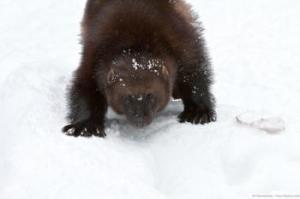
Wolverines are hanging on in the northern Mountain states—but maybe not for long. Photo by Vince Maidens
The University of Michigan’s mascot is the wolverine—a pretty good symbol for teams that want to terrify their foes. Real wolverines are the largest members of the weasel family, about as big as a medium-size dog, with a reputation for strength and ferocity.
But there aren’t any wolverines left in the Wolverine State. The last known specimen one was found dead nearly a year ago, which leaves only a few hundred at best in the lower 48 states, most of them in the mountains of Washington, Idaho, Montana and Wyoming.
They might not be able to hang on much longer.
A new study out of the National Center for Atmospheric Research in Boulder, Colorado explains what the problem is. The study, published in the journal Environmental Research Letters, points out that wolverines are exquisitely adapted to snowy climates. Their paws are big and padded, like natural snowshoes, and they depend on lingering spring snowpack for building their dens and protecting their young.
But climate change has taken a toll on the mountain snows in the mountain west. Winter snowpack is melting earlier than it once did, and climate simulations done with NCAR’s newest, most sophisticated climate model suggest that it’s going to get worse unless greenhouse-gas emissions are cut back significantly. Failing that, the snow that now lingers into spring could all but vanish by the second half of this century.
On top of that, some summer days are likely to go as high as 90F on in the wolverine’s stomping grounds, compared with the current maximum of 72. The thick-furred wolverines probably can’t handle that kind of heat–and it’s hard to see how they could evolve to do so, either behaviorally or biologically, on that time scale.
Their only choice is to move north to the Canadian mountains, where their cousins still live. Except that Canada is also warming: a study published last year showed that wolverine populations are dropping there too—again, probably as a result of reduced snow. They have a much bigger population to start with, but if conditions change rapidly and dramatic enough, it might not make much of a difference.