



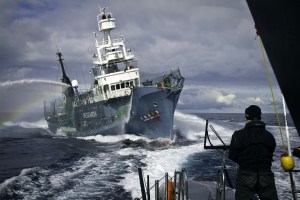
 The annual kerfuffle between Japanese whaling ships and the anti-whaling activists who chase them around Antarctic waters every winter is once again getting its seasonal share of ink and airtime. But this year the familiar scenes from the southerly tug-of-war might have a new victor – for now.
For the last several winters, the Sea Shepherd Conservation Society has chased around the whaling fleet Tokyo sends down to Antarctica to continue Japan’s annual whale hunt. Though there has been a global moratorium on commercial whaling since 1986, Japan continues to hunt whales in a loophole in the laws that permits whaling for scientific purposes. The scuffles between the Sea Shepherd activists trying to put a stop to this hunt and the Japanese fleet have been documented from the organization’s perspective in the sensationalist Whale Wars series on Animal Planet. Usually, the battle ends with the end of Japan’s hunt, and the activists vow to try again next year.
Yesterday, however, Japan announced they had suspended their whaling activities on Feb. 10 due, officials said, to persistent harassment from the Sea Shepherd. As of Thursday afternoon, Tokyo still had not said whether they were calling off the hunt for the season, which normally ends in March. Paul Watson, founder of the Sea Shepherd Conservation Society and captain of the Sea Shepherd vessel, said Japan’s whale processing ship had changed course and might be heading home. (UPDATE: On Friday, Tokyo announced the season’s hunt was, in fact, called off.)
(See TIME’s Top 10 Gratuitously Provocative Acts.)
It’s a massive coup for the militant eco group in their long fight against whaling that, for Japan, has seemingly become less about harpooning a few hundred whales than the national identity. Facing Sea Shepherd’s increasingly bold tactics and deafening PR machine, Japan has dug its heels ever deeper in the ocean floor, insisting on its right to cull whales under its scientific program and sell its meat under the international treaty, despite flagging demand (the national stockpile of whale meat stood at 5,093 tons in December, compared to 1,453 tons in 1999) and threats of international legal action from Australia if it doesn’t stop.
That Japan may have finally decided that the whales they will kill and process this year may not be worth the money or safety of their crew was greeted with approval and optimism from many environmental corners. Pew Environment Group director Josh Reichart released this statement on Wednesday:
“The Pew Environment Group welcomes the early departure of the Japanese whaling fleet from the Southern Ocean Whale Sanctuary. Commercial whaling does not belong in the 21st century. We hope that the removal of the fleet marks the end of all whaling in the Southern Ocean Whale Sanctuary, and that Japan confirms this exit is permanent at the annual meeting of the International Whaling Commission in July.”
It is doubtful, however, that this marks the end of the road for Japan and whaling. The film The Cove, which I personally found both an important documentary about the archaic practice of dolphin hunting as well as a little unfair to Japan, offered some insight into the importance placed on sovereignty, tradition, and ocean resources in Japan; the refusal to stop the relentless hunt and consumption of the endangered bluefin tuna offers another.
Whatever the outcome of the next few weeks, and whatever you think of the activists’ tactics, the Sea Shepherd has at least succeeded in making Japan seriously — and more importantly publicly — consider the question that the rest of the world has been asking for years:
Is this really worth it?