



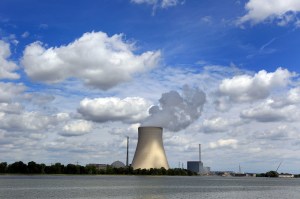
The cooling tower of a nuclear power plant
This week I wrote a piece for the magazine on what many energy analysts believe to be the future of the nuclear industry: small modular reactors.
These mini reactors, which generate up to 300 megawatts compared to 1500 megawatts for traditional large nuclear power plants, are all the rage because they are versatile and cheap. My story focused on the smallest of the small reactors–the 25 megawatt Hyperion Power Module (a.k.a the nuclear battery) which Denver-based Hyperion Power hopes will soon fuel subdivisions, mining operations, military bases, hospitals, desalination plants and even cruise liners around the world soon.
But it is a competitor, it seems, that may be the first company to break ground on a commercial mini reactor in the U.S. This week the U.S. Nuclear Regulatory Commission (NRC) revealed to me that the Tennessee Valley Authority, the U.S.’s biggest public utility, had exchanged letters with the NRC about receiving licensing for two small reactors at its Clinch River site—and the reactors will be designed by Babcock & Wilcox, a maker of nuclear-propulsion systems for the US Navy.
That’s significant because a problem facing Small Modular Reactors is that the NRC is already reviewing a dozen applications for new large reactor designs. The Babcock & Wilcox design, called mPower, is based on existing (but miniaturized) technology. That makes it more likely to have a smooth licensing process than more novel designs, the NRC told me.
The Hyperion Power Module is a new design, which the company says makes it more safe than traditional reactors but which the NRC, while not commenting the company’s claims on safety, says will require the module to undergo a particularly extensive review before it can be licensed.
Hyperion’s executives have expressed frustration at energy conferences about the NRC’s lengthy review process, and have said that it will likely build modules abroad first as a result. Not so fast, say the NRC, as any nuclear technology exported from the U.S. would need approval from several agencies, including the NRC.
So it may be Babcock & Wilcox that wins the race to be the first mini reactor by a U.S. company. Recently Babcock & Wilcox told The Economist that the company’s small reactor offers another advantage on top of mature technology: “Because it can use existing power-transmission lines without overloading them, the mPower can act as a “drop-in replacement” for ageing coal furnaces without the need for costly refurbishment.”
Hyperion power’s nuclear battery has all the gee-whiz factor of new technology–and it’s CEO may indeed be proven correct that the reactor is a “game-changer” for the industry. But as of now, it seems that it will be reactor with more a mature and tested design that will likely be the first small reactor licensed in the U.S. by the NRC.
(More on Time.com: See photos of the death of an aging nuclear power plant)