



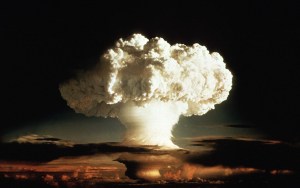
A mushroom cloud
Environmentalists: Wake up! There is a greater and more urgent threat to the climate than even global warming: the threat posed by nuclear weapons.
Why are nuclear bombs an environmental problem? We have long known that a large-scale nuclear war would lead to a sudden change in climate—called a nuclear winter—that could threaten all life on earth. But in the past decade, climate scientists have used advanced climate modeling to show that even a small exchange of nuclear weapons—between 50-100 Hiroshima-sized bombs, which India and Pakistan already have their in arsenal—would produce enough soot and smoke to block out sunlight, cool the planet, and produce climate change unprecedented in recorded human history.
Scary? It gets worse. New research by the National Center for Atmospheric Research (NCAR) suggests that the above scenario of a “limited” nuclear war would also burn a hole through the ozone layer, allowing extreme levels of ultraviolet radiation to reach the Earth’s surface, which would greatly damage agriculture and most likely lead to a global nuclear famine.
It seems it does not take a cold war posture of MAD—mutually assured destruction—to threaten civilization as we know it.
Presenting the research at the American Association for the Advancement of Science (AAAS) conference in Washington D.C. last week, NCAR scientist Michael Mills explained that the heat and soot in the stratosphere following limited nuclear war would lead to “low-ozone” columns over cities, which would increase cancer rates and eye damage dramatically. But the ozone loss would be so great that it would also have serious repercussions for plant life, including “plant height reduction, decreased shoot mass, and reduction in foliage area” and long-term genetic instability. Another risk is depletion of phytoplankton that feed sea life.
“It would be very difficult for us to grow the type of crops we grow today,” Mills said, according to Global Security Newswire. “In addition to ecological damage, there would be a global nuclear famine.”
Since the end of the Cold War, the threat of global nuclear war has diminished. So, in turn, has concern among the world’s population and political leaders about the presence of nuclear weapons.
But there are still 20,000 nuclear weapons on the planet as I type this. And as I have argued in the past, simple probability theory tells us that if these nuclear weapons exist indefinitely, they will definitely be used. While it may be difficult to imagine an intentional nuclear war between Russia and the U.S, an accidental exchange remains a threat. And as the New York Times editorial page warned on Feb. 20, Pakistan and India are locked in a dangerous—but often overlooked—nuclear arms race.
The presence of nuclear weapons—and the potential proliferation of atom bombs to new countries—is a grave environmental threat. Greens need to wake up to this reality, and recognize they should do more to protect the climate than fret over carbon emissions. It’s time for environmentalists to renew an old slogan: Ban the Bomb. Now.
(More on TIME.com: See pictures of Hiroshima)