



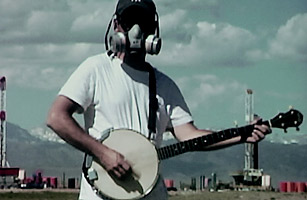
Gasland Credit: HBO
If you watch the Academy Awards show on Sunday evening, you might notice Mark Ruffalo—nominated for Best Supporting Actor—and a number of other celebrities wearing a blue water droplet pin. The pins come from WaterDefense.org, a new campaign that is calling attention to the drinking water supplies that activists say are being threatened by the oil and gas drilling—especially the latter.
Those blue pins won’t be the only sign of growing public concern over water supplies and gas drilling you’ll see at the Kodak Theater on Sunday. Among the five films nominated for Best Documentary is a scruffy feature called GasLand. Directed by Josh Fox—a New York-based filmmaker and experimental theater director—GasLand follows Fox as he explores the growing shale gas industry. He starts in his home in northeastern Pennsylvania—ground zero for gas drilling in the valuable Marcellus Shale—prompted by what he says is a $100,000 offer for drilling rights on his property. From there, Fox digs into the drilling industry and the controversial method used to capture gas in shale formations—hydraulic fracturing, or hydrofracking. (For more than you could ever want to know about hydrofracking, check out ProPublica’s long-running investigative series on the subject.)
Shot in a shaky handheld style in washed-out or hyperbright colors—think of an entire documentary shot through a Hipstamatic lens—and overlaid with Fox’s foreboding narration, GasLand becomes a savage attack on shale gas. Fox finds homeowners in Pennsylvania and later in Colorado and Wyoming who claim that wells drilled near their land have poisoned their water. (At one point, Fox shows drinking water at a house near a well catching fire—the result, he says, of methane contamination from drilling.) He alleges that the industry has covered up the potential environmental risks of hydrofracking, with the willing assistance of state and federal regulators. This is a muckraking environmental documentary in the style of Michael Moore—if Moore were a skinny New York artist in fashionable black-frame glasses.
GasLand stirred up controversy even before it premiered on HBO last June. Energy in Depth—a PR initiative of the Independent Petroleum Association of America (IPAA)—posted a detailed critique of Fox’s film in early June, accusing him of mischaracterizing drilling and hydrofracking and glossing over facts that contradicted his anti-fracking case:
Unfortunately, in the case of this film, accuracy is too often pushed aside for simplicity, evidence too often sacrificed for exaggeration, and the same old cast of characters and anecdotes – previously debunked – simply lifted from prior incarnations of the film and given a new home in this one.
Fox responded in turn, posting a document called Affirming GasLand in September, countering industry objections point-by-point:
I am issuing the following point-by-point rebuttal of their claims, not because I feel obligated to address what are clearly falsehoods and smear tactics, but to show the depth of the industry’s assault on the truth and to point out their obfuscations, misleading spin on information, and attempts to shut down questions about their practices.
But the battle really kicked into high gear after GasLand‘s Oscar nomination was announced in January. Lee Fuller, the executive director of Energy in Depth, sent a letter to the Academy of Motion Picture Arts and Sciences, reiterating the group’s earlier critique and calling for GasLand to be disqualified from the Best Documentary category on the grounds that it was more a work of fiction than of fact:
The many errors, inconsistencies and outright falsehoods catalogued in the appendix attached to this letter – and the many more we withheld for sake of brevity – cast serious doubt on GasLand’s worthiness for this most honored award, and directly violate both the letter and spirit of the published criteria that presumably must be met by GasLand’s competitors in this category.
When I spoke to Fox in early February, he dismissed the flak from the gas industry. “It just shows that we’re a threat to them,” he said. “It’s not going to stop us from doing our work.” And indeed, GasLand has gone from a documentary to a rallying point for those opposed to hydrofracking. Fox hosted screenings of the film throughout the areas affected by shale gas drilling, and in New York state, which has ample gas resources but which hasn’t yet been drilled, in part because of concerns over water contamination. Ruffalo, who has a home in upstate New York, has joined forces with Fox in fighting against hydrofracking—the two traveled to Washington on February 17 to lobby members of Congress on the issue.
Is there truth in GasLand‘s critique of hydrofracking and the natural gas industry? It’s worth seeing the film for yourself, if only because the fight over natural gas is only going to get hotter in the months and years to come, especially if unrest in the Middle East keeps oil prices climbing and gas suddenly looks like a welcome alternative. Mike Soraghan of Greenwire has done an admirable job comparing each side’s complaints while groundtruthing the film—check out his evenhanded take. To me, it looks like both Fox and the drilling industry have taken some liberty with the facts and relied on technicalities to push their points, but there seem to be no killer errors in the film, no knockout blow. “We stand behind everything there,” said Fox.
There’s no requirement that Oscar-nominated documentaries be perfectly even-handed—last year’s Oscar-winning documentary The Cove took some narrative liberties as it detailed the slaughter of dolphins in the small Japanese town of Taiji, and its fellow nominee Food Inc. faced a similar debunking effort from agribusiness. But the debate over natural gas and hydrofracking isn’t going to be settled by a single documentary. As drilling continues to increase around the country—including in parts of the U.S. that aren’t accustomed to energy exploration, such as the Northeast—resistance from unhappy locals and environmentalists will only amplify. But gas seems here to stay—the government has more than doubled estimates of U.S. gas reserves, mostly on the basis of shale plays, and President Obama himself seems ready to include natural gas in his vision of a cleaner energy economy. There’s a good reason for that—gas burns cleaner than coal and has a smaller carbon footprint, though opinions differ on just how much cleaner it is.
The war is just heating up—on Sunday, the New York Times will publish the first of a series of investigative pieces on natural gas drilling. As for Fox, he says he’s working on a follow-up to GasLand, and he’ll be in Los Angeles Sunday for the Oscars. Whatever the controversies, GasLand still isn’t the favorite to win its category—that would be Exit Through the Gift Shop, a documentary by the street artist Banksy that has its own complicated relationship to the truth.