



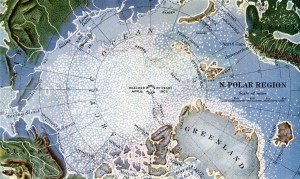
Map of the polar region, showing Peary's 1909 route to the North Pole. (Corbis)
For all its remoteness, the North Pole generates a lot of controversy. In 1909, the American admiral Robert Peary reported that he successfully reached the geographic North Pole, a feat of navigation that is now widely disputed. Nearly a century later, another expedition to the remote top of the globe caused a stir when Russian submarines planted a three-foot tall titanium flag on the sea bed miles beneath the pole, going outside the global bodies that oversee the region to stake a claim to the unowned spot on the planet.
Now CNN has another interesting report on its breaking news blog: According to Danish press, Denmark is preparing to make its own official request to the United Nations to recognize the North Pole as part of the Kingdom of Denmark. The basis of Denmark’s reported claim is that the pole is geologically connected to Greenland, the world’s largest island and a semi-autonomous territory of Denmark.
The news, which the Danish paper Information says is confirmed by the Danish Foreign Minister, comes at an intriguing moment: just days after a meeting of the Arctic Council in Nuuk, Greenland’s capital, which was notably attended by U.S. Secretary of State Hillary Clinton, and also after WikiLeaks released a flurry of cables written between 2007 and 2010 that underscored Arctic nations’ anxiety over who owns what at the roof of the world.
Though five nations — Denmark (via Greenland), the U.S., Russia, Norway and Canada — have land that circles the North Pole, no one has ever formally made a claim it. (The Russian flag, evidently, didn’t count.) In 2014, the UN body that oversees the region is due to look at competing geographic claims about what part of the seabed is connected to what country, and perhaps start to map out who can claim legal ownership of what in the Arctic.
With little oil and gas resources believed to be beneath the Pole itself, as well as a publicly stated intention to support Greenland in its quest for autonomy, why Denmark is gunning for this is still unclear. Certainly, foreign interest in natural resources in parts of the Arctic with proven resources, such as off the coast of Greenland, has grown since 2007. Greenland, which has long been trying to figure out a way to secure its autonomy from its colonizer but has little industry of its own to make independence viable, is extremely keen on partnering with international energy companies to tap into its natural resource potential. The revenues it would receive from a large find could help set the island free from the large Danish subsidies it relies on.
The handing out of licenses for exploratory drilling off Greenland’s coast in the past few years has raised many concerns about drilling in the pristine Arctic, particularly in the wake of the BP spill. But according to another leaked report from the Danish government, it appears those concerns are not shared by Denmark or its territory. According to an article published on Tuesday in the English language Copenhagen Post: “Another Danish strategy report… that was leaked to [Danish news outlet] DR on Monday, stated that, in the future, Arctic policy would “be driven first and foremost by Greenlanders’ rights to growth and well-being”, not environmental concerns.”
The Danish government has said that it supports Greenland’s path towards independence. But I’ve always been a bit skeptical that Copenhagen will be quite so supportive when an oil company strikes it so big in drilling offshore that Nuuk can afford to govern itself. And on the off chance the UN does grant the Danish Crown ownership of the North Pole, will Denmark also hand that over to Greenland when the day finally comes? I wonder.