



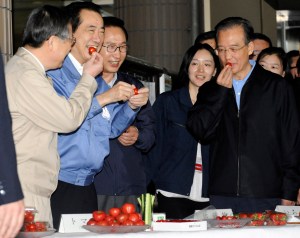
Chinese Premier Wen Jiabao, South Korean President Lee Myung-Bak, and Japan PM Naoto Kan eat tomatoes from Fukushima prefecture in Fukushima city on March 21 (AFP)
On Saturday, the leaders of the world’s second, third and 15th largest economies got together in Fukushima City and ate veggies to demonstrate how safe it is to do just that. I think it’s always a little embarrassing to observe politicians in orchestrated eating and/or drinking events (see Obama’s three-guys-just-having-a-beer moment at the White House with the Cambridge, Mass. police chief and Henry Louis Gates Jr. — cringe). Watching Chinese Premier Wen Jiabao primly tuck into a non-irradiated cucumber spear didn’t improve my feeling about this kind of theater.
Nevertheless, it was more helpful than import bans. Wen and South Korean President Lee Myung-Bak went to Japan’s disaster-struck region over the weekend to express their sympathy to residents and to kick off a new period of cooperation in a region beset with both long-playing historical grievances and recent geopolitical squabbling. Despite the complicated feelings that China and South Korea have harbored about the archipelago since their respective occupations by Japan, both nations were the among the first to send rescue teams after the 9.0 quake and ensuing tsunami destroyed much of Japan’s northeast coast on March 11.