



A guest post from TIME’s Feifei Sun:
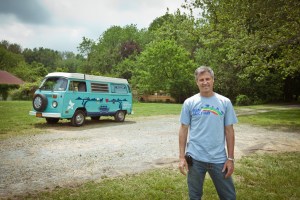
In 1986, Gene Baur started selling veggie dogs out of his aqua blue Volkswagen van to raise money for Farm Sanctuary, an animal rights organization he co-founded with his then-wife. This May, Baur hopped back into his van to embark on a road trip across America, called the Just Eats Tour (which ends June 4 in Orland, CA), to celebrate his organization’s quarter-century run by highlighting the country’s latest vegan movements. TIME caught up with Baur on the road to talk about his proudest accomplishments during his 25-year tenure, the next animal rights initiative Farm Sanctuary plans to back and what it’ll take to get the vegan movement to stick.
What inspired the Just Eats Tour?
The idea to go cross country was to explore vegan America. I believe we’re now in the midst of a food movement where people are moving away from supporting industrialized factory farming, which had been a growing approach for decades. I think people in recent years have come to recognize the cruelty associated with factory farming, the human health consequences and also the environmental harm caused by animal agriculture, and I think we’re seeing a move to plant-based food systems.
What’s been your proudest accomplishment since co-founding Farm Sanctuary in 1986?
Bringing these things to a mainstream consciousness. And that’s been done through a variety of ways. One of our most significant initiatives was Proposition 2 in California, which passed [on November 4, 2008] to outlaw some of the inhumane confinement of animals on these factory farms. But then also in the early ‘90s we got Burger King in Watkins Glen, NY to sell a veggie burger that’s now being sold nationwide, which is significant as well. I believe if vegan food is available, people are going to be inclined to purchase it.
Which initiative are you focused on next?
The farm bill, which is coming up for discussion in 2012. It’s a very contentious battle every time this thing comes up, but what we’re hoping to do is start moving federal support away from industrialized animal agriculture and commodity crops, such as corn and soy beans—which are used for feed for animals—and move that support more in the direction of plant-based agriculture, farmer’s markets, community-supported agriculture programs and a food system that is good for rural America, good for consumers and good for animals.
You’re a strong proponent for a vegan lifestyle. But what do you say to people who think animals are a lesser species and just love their meat?
For people who say that animals don’t deserve better, I would say that what we do to animals says perhaps more about us than it says about animals. And if we have complete control another individual, and they may want to portray them as a lesser individual, then that says something about us. These animals are at our mercy, and if we treat them with cruelty and callousness, I think that we need to look in the mirror and ask ourselves if that’s okay. And some people if they say it’s okay, I don’t quite understand that. I think humans naturally are empathetic, and to see another suffer—whether it be a human or animal—and to not feel something and not be upset about it… I think that’s pathological, frankly. Sociopaths are defined as those who don’t have empathy.
The vegan lifestyle seems to get a lot of media attention every time a new documentary or book comes out. What’s it going to take for these issues to remain in the spotlight?
Those books and movies are all part of the process for increasing awareness, and I think we are gaining ground with people knowing about the cruelty of factory farming and recognizing we can live without eating meat, eggs or milk. But change happens over time incrementally, and I do believe there is progress being made…. The number of farmer’s markets is increasing, community gardening is increasing in popularity, there are more and more vegan restaurants popping up. And mainstream grocery stores now have vegan items routinely, so I think those are all indications that the market is in this better direction.