



Thanks to the spring from hell—in the U.S., at least—much of the concern about climate change has shifted to the fear of the violent weather that could become the norm in a warmer world. (See Sharon Begley’s sobering take in Newsweek.) But while tornadoes and hurricanes and floods may get our attention, the greater threat from warming could be a quieter, slower and much less dramatic. For parts of the tropics and subtropics, the world in the future could be too warm to farm, with devastating humanitarian consequences for tens of millions of people, many of whom already live in poverty.
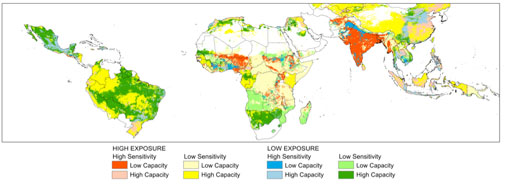
That’s the conclusion of a scary new study (PDF) from the Climate Change, Agriculture and Food Security (CCAFS) program, a part of the Consultative Group on International Agricultural Research (CGIAR), a global group of food research organizations. The group identified future climate change “hotspots” that are expected to suffer brutally high temperatures during growing seasons in the future, and matched them with areas that were already suffering from food insecurity. The result is a map of suffering for much of Africa and South Asia, and possibly parts of China and Latin America as well. “When you start to hit 30 C your crops start suffering, and that’s going to happen here,” says Andy Jarvis, a fellow with the International Center for Tropical Agriculture, another subgroup of CGIAR.
A couple of maps from the report give an idea of what’s likely to happen. The first shows which areas are likely to suffer significant reductions in crops, and which ones are better prepared to deal with the changes:
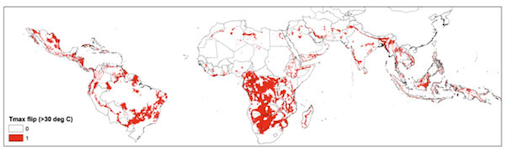
And here’s another that shows where average max temperatures during growing seasons are expected to rise above 30C—the point at which many crops simply begin to fail:
The maps and the reports are a reminder of one of the inescapable facts of global warming politics: those who are least responsible for the problem, those who are already living close to the edge, are those who will almost certainly suffer the most. “It’s just a perfect storm,” Jarvis says. “The food is going to have to come from somewhere.”
That leaves much of the responsibility in the hands of the developed nations, whose wealth will shield them from the worst impacts of climate change—provided they plan well. Reducing emissions is a must, to blunt the worst effects of warming. (Although keep warming to just 1.5 C above pre-industrial levels, as UN climate chief Christiana Figueres called for today, will require a time machine given the amount of warming we’ve already built into the atmosphere with our past greenhouse gas emissions.) But adaptation will be just as important—if not more so. That means investment in agriculture and farming research, better breeding and better crops, fertilizer and irrigation. (Perhaps reforming global agricultural subsidies to give developing world farmers a fairer shake wouldn’t be the worst idea in the world.) In short, we’ll need to help with the hard work of international development—which in a hotter world, is all but synonymous with climate adaptation. “Adaptation is a hundred little things,” says Jarvis. “We need to do development better and faster.”
Given that perhaps the only thing the rich nations of the world have performed worse on than climate change is international development, that’s not a comforting thought. But we don’t have any other choice. As diplomats gather for yet another round of climate negotiations—this time in Bonn—I’d rather see governments make concrete pledges on adaptation, foreign aid and technological development, instead of another empty promise about preventing temperature rise or keeping the atmosphere’s carbon concentrations at a “safe” level. Action now is worth a lot more than promise tomorrow.
[youtube=http://www.youtube.com/watch?v=NaiqWsQTeZ8]