



Cameron Davidson / Getty Images
This week we learned that bad planning in the face of climate change isn’t a particularly new phenomenon: the Vikings did it too. The collapse of the Norse settlements in West Greenland was caused, in part, by the Vikings’ poor adaptation to cooler conditions and extensive sea ice over 1,000 years ago, which severely affected Norse livestock and crops.
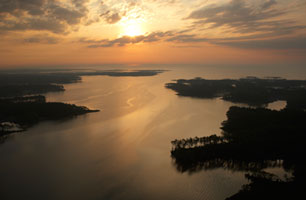
A millennium later, it looks like North Carolina will suffer the consequences of climate change as well if we don’t adjust our lifestyles. Scientists have found evidence that over the past century, the Tar Heel state has suffered the steepest climate-associated sea level rise of the past 2,000 years. The coastal erosion that accompanies these rising sea levels, left unchecked by poor management, will bring significant losses to North Carolina – but this time it is property values, quality of life, and tourism that will be affected, and by climate change-induced temperature shifts in the other direction.
The research team, led by Andrew Kemp of the University of Pennsylvania’s Department of Earth and Environmental Science, found that sea levels have risen at about 2.1 millimeters per year since the late 19th century, compared to a rate of only 0.6 millimeters per year around the Middle Ages. Sea level was stable from B.C. 100 to A.D. 950, according to the scientists.
“This historical rate of rise was greater than any other persistent, century-scale trend during the past 2100 years,” the researchers wrote in the study, published in the Proceedings of the National Academy of Sciences.
The team analyzed sea level changes of the past two millennia using data extrapolated from salt-marsh sediments and foraminifera – single-celled protists present all over the ocean – and reconstructed global mean temperature using proxy data from natural climate archives. Combining the two data sets, Kemp and his team found the sea level changes consistent with the global temperature changes of the past 1,000 years.
“This research…suggests that modern warming is unprecedented in the past two millennia,” they wrote.
But why should we care about a barely perceptible increase – about the thickness of a nickel – in sea level each year? Because in North Carolina, a nickel-thick water rise could eventually mean billions of dollars in economic loss. A 2007 report by leading North Carolina researchers projected that billions of dollars in property value and coastal recreation will go down the drain by 2080 because of rising sea levels and the accompanying coastal erosion. The swelling oceans also magnify the state’s vulnerability to severe storms, which spells bad news for North Carolina’s agriculture, tourism, and other business sectors. And in case you’re wondering why the losses are so severe, here is your answer: the state has been identified by the National Oceanic and Atmospheric Administration as one of the most vulnerable regions to sea level rise in the U.S.: it has the largest estuarine system on the U.S. Atlantic coast and is home to over 2,000 square miles of coastal and urban land below one-meter elevation.
That’s quite a lot of damage from a change in sea level, even if it’s only as thick as a nickel each year. And so as the earth warms and the glaciers on the poles melt, we need to remember the Norse collapse and adjust our values and lives accordingly as more information becomes available. As Jeffrey Kluger reminded me earlier today, studies like these mean we have no excuse for being unprepared.