



Getty Images
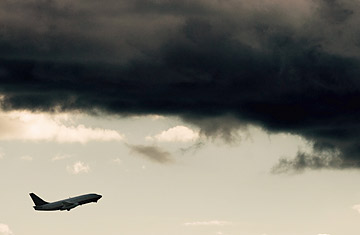
If you’ve ever looked up at the sky when you hear the hum of an airplane, chances are you’ve seen the channels, streaks, and halos that sometimes pattern the sky in the aircraft’s wake. These cloud constellations can happen because of temperature changes as airplanes pass through certain clouds, as we learned in 2010. But this year researchers have found that airplanes don’t just punch holes in the clouds: they can also make rain and snow fall.
Their study, led by the National Center for Atmospheric Research, showed that areas around commercial airports like London’s Heathrow and Chicago’s O’Hare International Airport experience more rain and snow when airplanes take off and land. This happens under certain atmospheric conditions – cloud layers with temperatures about 5 degrees Fahrenheit or lower, for example. When planes fly through these cloud layers, the tips of their propellers make the surrounding air rapidly expand and cool. The supercooled water droplets in the clouds then freeze into ice particles and turn into snow or rain as they fall to the ground, leaving behind both changed weather and the intricate gaps in the clouds that you may have seen on a lazy Sunday afternoon.
Photos from TIME: Airbus Imagines ‘Plane of the Future’
“It appears to be a rather widespread effect for aircraft to inadvertently cause some measureable amount of rain or snow as they fly through certain clouds,” lead scientist Andrew Heymsfield told TIME. “This is not necessarily enough precipitation to affect global climate, but it is noticeable around major airports in the midlatitudes.”
The major airports Heymsfield is talking about – besides Heathrow and O’Hare – include Germany’s Frankfurt, Paris’ Charles De Gaulle, Washington’s Seattle-Tacoma, and Canada’s Yellowknife, as well as Byrd Station in Antarctica. If you’re taking off from Frankfurt, De Gaulle, and O’Hare, you’re more likely to see rain and snow, with conditions being ideal over 5% of time in a year; the number is smaller for Heathrow, Frankfurt, and Seattle Tacoma at 3%. The right conditions happen somewhat more frequently in colder climates, the study said, and Heymsfield added that the phenomenon probably occurs at lots of other airports in mid- and high- latitude areas when it’s cold outside.
Heymsfield’s figures come from satellite images and weather forecasting computer models quantifying how often specific cloud conditions occur within 62 miles of their chosen airports. 62 miles isn’t an arbitrary figure – that’s about how far a commercial aircraft needs to travel to get to above 10,000 feet, which is where most supercooled cloud layers are. The satellite images were particularly revealing, Heymsfield said. “Some of the airplanes would be flying along and would do a 45 degree left turn, and in the [satellite images of clouds] we were actually able to identify where individual aircrafts made these turns because they were unmistakable. They showed up in the holes.” The images also revealed that the holes happen pretty often – a cloud layer over Texas in 2007 had 92 holes, for example; some of which stayed there for over four hours and reached lengths of 60 miles or more.
More from TIME: Air Travel: Extra Fees
So should we be concerned that these holes and the resulting weather changes mean a quick trip to the tropics is going to worsen our fragile climate? Thankfully no, according to Heymsfield, though it’s possible that air travel will mean we get out the snow shovels more.
“When it’s overcast and temperatures are fairly low… airplanes flying up through the cloud layer possibly generate more snow in the ground around those areas, or snow in areas where there might not normally be snow,” he said. Heymsfield remembers analyzing radar readings that showed an inch of snow falling per hour at the Denver International Airport – where snow doesn’t fall all that much – after several planes had passed through the surrounding clouds. And any kind of aircraft can make it rain and snow – jet or propeller, private or commercial. Conventional thinking was that the “hole-punch” phenomenon could only be caused by airplanes with propellers, according to Heymsfied.
“But it was every imaginable kind,” he said. “Given the correct circumstances, this effect probably happens when the conditions are suitable for any type of aircraft.” So as the world gets smaller and air travel keeps increasing and innovating – a solar powered-airplane had a successful test flight this month – we may start seeing more rain and snow as we lug our suitcases through the airport. Definitely something to think about if you get bored on your red-eye home this Fourth of July weekend.
More from TIME: 20 Reasons to Hate the Airlines
More from TIME: Future of Air Travel: Airbus Predicts ‘Transparent’ Airplanes, 9 Billion Customers, By 2050