



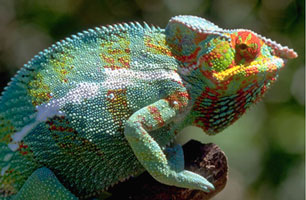
A panther chameleon clings to a tree branch in Madagascar. Scientists from the University of Exeter predict that many amphibians and reptiles endemic to Madagascar will soon lose their habitats due to climate change. Wolfgang Kaehler / Corbis
With all the climate conversation currently littering the Internet, and the myriad ways that extreme weather is linked to global warming, it’s hard not to get confused about climate change sometimes – and given the sheer volume of muddled information out there, you might even be forgiven for being unconvinced by the arguments thus far. But University of Exeter scientists have brought us some simple proof that climate change seems to be as bad for our planet as we’ve been led to believe. Their study shows that the loss of animal and plant species that have already happened match previous predictions in terms of the relative risk to different species around the world. And based on that information, the scientists have made a frightening forecast: one in 10 species will be extinct by 2100 if climate change continues affecting the world the way it is now.
“Our study is a wake-up call for action,” lead author Ilya Maclean said in a statement. “The many species that are already declining could become extinct if things continue as they are. It is time to stop using the uncertainties as an excuse for not acting.”
More from TIME: Has “China Sky” Helped Slow Global Warming?
Admittedly, the study comes with no shortage of uncertainties — aftr all, it’s difficult to control for external factors when modeling the natural world. But Maclean’s team drew from established sources for their conclusions: the IUCN Red List and widely published research showing how animals and plants from all types of habitats are already responding to climate change across the globe. They used the former for population data and the latter to check if predictions were wide of the mark. Based on this review, which is the largest one ever done of such studies, it looks like predictions have been accurate – and perhaps even a little too conservative.
“By looking at such a range of studies from around the world, we found that the impacts of climate change can be felt everywhere, and among all groups of animals and plants,” study author Robert Wilson said. “From birds to worms to marine mammals, from high mountain ranges to jungles and to the oceans, scientists seem to have been right that climate change is a real threat to species.”
More from TIME: Dust Storm!
And how exactly is climate change bad for flora and fauna? For one thing, migration and breeding cycles are extremely temperature sensitive, mostly because of how much food availability is affected by the surrounding climate. Climate change can also cause habitats to shift northwards and up mountain ranges to cooler spots, forcing species to change their distribution ranges. In doing so they often face natural obstacles like the sea that are, well, kind of large and hard to overcome. Not to undersell the earth’s species – they’re pretty hardy, and can sometimes evolve quickly – but adaptation takes millions of years, and climate change is happening too fast for us to wait for that kind of evolutionary change. Take some of these responses to climate change compiled by the scientists:
Decreased ice cover in the Bering Sea reduced the abundance of bivalve molluscs from about 12 to three per square metre over a very short period of time (1999-2001). These shells are the main food source for species higher up the food chain, such as Spectacled Eider.
Climatic warming and droughts are causing severe declines in once-common amphibian species native to Yellowstone National Park in the United States of America. Between 1992-1993 and 2006- 2008, the number of blotched tiger salamander populations fell by nearly half, the number of spotted frog populations by 68 per cent, and the number of chorus frog populations by 75 per cent.
And these are some of the team’s predicted responses to climate change:
On Tenerife, an endemic plant, the Caňadas rockrose has a 74 to 83 per cent chance of going extinct in the next 100 years as a result of climate change related droughts.
In Madagascar, climate warming is predicted to cause endemic reptiles and amphibians, often found in mountain ranges, to retreat towards the summit of the mounts. With a warming of just two degrees Celsius, well within current projections, three species are predicted to lose all of their habitat.
Those are some pretty bleak forecasts, but maybe that’s the impetus we need to push ourselves into action. That several predictions of the effects of climate change have come true brings us tangible proof that we must mobilize what we can to create our most effective insulation against the climate crisis. The data might be confusing, and critics will always call into question its accuracy, but – as Maclean said – uncertainties can only be our excuse for so long.
Tara Thean is a TIME contributor. Find her on Twitter at @TaraThean. You can also continue the discussion on TIME‘s Facebook page and on Twitter at @TIME.
Photos from TIME: The best pictures of the week