



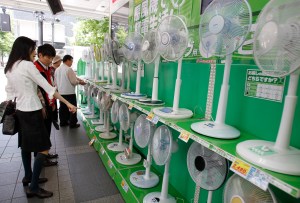
Customers inspect fans in Tokyo on May 21, 2011. (AP Photo/Koji Sasahara)
Nobody likes a 40-year heat wave, but a 40-year heat wave in the midst of national drive to conserve energy seems particularly cruel. Last month, residents of Tokyo and other parts of Japan, where electricity is in short supply after March 11, endured highs of 95 degrees — and pangs of guilt when they reached to turn the temperature gauge down a notch in their homes and offices. In the grip of power-saving patriotism, the government said that nearly 7000 people — three times more than last year — were hospitalized around the country with heatstroke in June.
But with a shortage that looks doomed to get worse before it gets better, Japan faces many more months of living without creature comforts of a cool home or a heated toilet seat. Right now, only 19 of the nation’s 54 nuclear reactors are producing power. The rest have either been shut down due to safety concerns after Fukushima or for routine maintenance, and still more are expected to go offline for repairs in coming months.
On Monday, the Japanese government announced a muddled plan aimed at getting some of the reactors back up to stave off a major power shortage. The plan involves two phases of “stress tests” to evaluate reactors’ ability to withstand disasters and accidents on the scale of the March 11 earthquake and tsunami. The first phase would test plants that have been shut down for routine maintenance, presumably to get those back online as quickly as possible, and the second phase would be a wider test of all of the nation’s nuclear power plants, including those that are currently operational.
(Read TIME’s full coverage of the March 11 disasters.)
The Nuclear Safety Commission (NSC), an independent body, will conduct and compare the new safety tests against the previous safety assessments of the Nuclear and Industrial Safety Agency (NISA). NISA, which falls under the Ministry of Economy, Trade and Industry (METI), has come under fire since the crisis at the Fukushima nuclear power plant, in part because of the agency’s conflicting roles as both monitoring the safety of Japan’s nuclear plants and promoting Japanese nuclear technology for export.
But the two-phase plan, designed to bolster confidence that nuclear power in Japan is safe, has had the unintended effect of suggesting a lack of consensus within the government itself on whether Japan’s reactors are safe or not. METI, after confirming that all of Japan’s reactors were compliant with new post 3/11 emergency measures, had already announced that Japan’s reactors were safe when Prime Minister Naoto Kan called for the stress tests. Now some local governments, which had been ready to authorize the resumption of operations at reactors that had been shut down for maintenance, are unsure how to proceed. At least 10 reactors around the country, shut down for routine repairs, were scheduled to restart between March and September.
The more immediate problem, however, is that the government did not give a timeline as to when the tests would be conducted and completed. So questions remain as to whether Japan will, in fact, avoid power shortages this summer and winter. That timeline didn’t get much clearer on Tuesday, when Kan said the government would unveil a new, long-awaited energy plan that de-emphasizes nuclear power and incorporates more sustainable power sources “in the not too distant future.”
In the meantime, there’s the pool.
Krista Mahr is a reporter at TIME. Find her on Twitter at @kristamahr. You can also continue the discussion on TIME’s Facebook page and on Twitter at @TIME.