



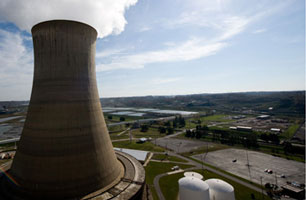
American Electric Power's (AEP) Mountaineer coal power plant in New Haven, West Virginia. Plans for a full-scale carbon capture project are now on hold indefinitely. Saul Loeb / AFP / Getty Images
If Congress had the wherewithal to establish a robust energy and climate change policy, there might have been a transformative bit of construction underway right now, next to the towering Mountaineer coal power plant, in New Haven, West Va. Mountaineer, like nearly every other coal plant in the world, pours tons of carbon into the atmosphere as a result of burning the planet’s dirtiest fuel. The new construction would have solved that problem in a straightforward way — by capturing the carbon rather than releasing it and storing it deep beneath the ground.
The technology is known formally as carbon capture and sequestratian (CCS), and it actually works pretty well in a small pilot plant Mountaineer already had up and running. The next step was to take that up to scale, but last week, American Electric Power (AEP), Mountaineer’s owner, announced it was canceling the new project. What scrubbed the plan is what scrubs so much that Washington gets near: politics and money.
President Obama entered the White House with a plan to implement a comprehensive cap and trade program that would have put a price on carbon, limiting the amount that could be released and allowing manufacturers to trade carbon credits. Those who exceeded the ceiling could effectively buy the right to release more from those who came in under the limit. The same system was used to reduce the sulfur dioxide emissions that had been the principle cause of acid rain. The House actually passed a cap and trade bill in 2009, but it promptly languished in the dysfunctional Senate, where GOP lawmakers dubbed it “cap and tax” and filibustered it to death.
AEP had set aside $668 million to build its full-scale CCS plant. That kind of outlay would have required the company to raise the price it charges for electricity, but part of the point of cap and trade is to make carbon more expensive across the market, encouraging conservation and the development of clean alternatives. AEP’s price hike thus would eventually have been consistent with the industry’s as a whole. With no climate plan in place, however, that egalitarian system falls apart. The result: the new plant was canceled, CCS technology stalls and the world gets warmer.
“The reason why projects like these are fiscally challenged is because the incentives available to them fall short and the rules of the road in terms of emissions standards aren’t clear,” Clean Air Task Force Carbon Storage Development Coordinator Kurt Waltzer said.
More from TIME: See the top 20 green tech ideas.
That’s especially disappointing because AEP and other developers have worked hard to bring CCS to scale and have made a lot of progress. “As far as I can tell, this [cancellation of the plant] is not in any way a reaction to surprises in the research and development program, nationally or globally,” Princeton University Carbon Mitigation Initiative co-director Robert Socolow said. And according to senior research engineer at MIT’s Carbon Capture and Sequestration Technologies Program Howard Herzog, the technical challenges with AEP’s pilot plant have all been manageable, even after scaling up from the initial smaller models. “There are always issues when you scale up, but fundamentally it works,” he said. With regulatory uncertainty and the resulting unclear and unconvincing incentives that come from that, the one thing that doesn’t work is the fiscal arithmetic.
That’s not to say that carbon sequestration is yet as mature a technology as wind power or even solar, but it’s probably ahead of bio-fuels by now. Still, there are plenty of question marks. For one thing, we don’t know yet whether the carbon will stay underground indefinitely – carbon dioxide, like oil, can leak. And getting that gas into the ground in the first place uses up a phenomenal amount of energy, because it needs to be compressed into a liquid – consuming more energy than is used burning the coal in the first place. Finally, the operation of CCS plants is hugely expensive. The Department of Energy ultimately would have picked up half of AEP’s $668 million tab, but that $334 million would not have come free; it’s taxpayers who would have been footing the bill for that share. Of course, answering technological and economic questions is the whole reason you go from a pilot project to a first full-scale plant.
More from TIME: Talking Energy with America’s Greenest Coal Exec
The abandonment of the CCS project is a dismaying step backwards from the long-term goal both of helping Big Coal tame its dirty ways. All the technology in the world is useless without a full-bodied climate change bill and solid political momentum propelling it forward. “We’re losing valuable time,” says Socolow. In a world in which China and other nations are getting serious about sustainability, we’re losing credibility too.
Tara Thean is a TIME contributor. Find her on Twitter at @TaraThean. You can also continue the discussion on TIME‘s Facebook page and on Twitter at @TIME.