



In this Monday, July 25, 2011 image made off video released by the International Atomic Energy Agency, IAEA Director General Yukiya Amano, center, wearing protective gear, makes his way during his inspection tour at the crippled Fukushima Dai-ichi nuclear power plant at Okuma, northeastern Japan. (Photo: IAEA / AP)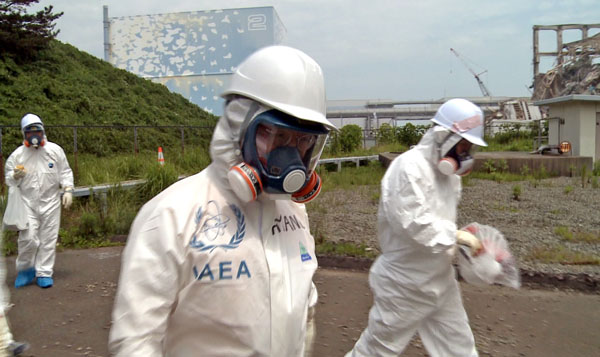
A newly released document says the Japanese government estimated in April that some 1600 workers will be exposed to high levels of radiation in the course of handling the reactor meltdowns at the stricken Fukushima Dai-ichi nuclear power plant.
The figure was released in a document from the Ministry of Economy, Trade and Industry (METI), which is in charge of regulating Japan’s nuclear industry, after the Japan Occupational Safety and Health Resource Center requested the information be made public, according an article published on Thursday in the Mainichi Daily News.
The government defines high exposure levels for workers as over 50 millisieverts per year. Under normal Japanese law, it is illegal for nuclear workers to be exposed to more than 100 millisieverts per year, but in the wake of the March 11 crises, the government raised the exposure limit to 250. The April 25 document, however, expresses concern for the safety of its dozens of other reactors: if this many of nuclear workers face such high exposure, they may be not be able to legally work at other nuclear plants in the coming year.
The number, it should be noted, is only an estimate. To date, only six workers have been recorded as exposed to more than 250 millisieverts per year, and less than 420 workers have been recorded as having been exposed to 50.
Meanwhile, on Monday, IAEA head honcho Yukiya Amano donned his own protective gear to get a look at the grounds of the crippled plant with members of Tokyo Electric Power Company (TEPCO). (You can tell which one Amano is because, well, his name is written all over his white suit.)
[youtube http://www.youtube.com/watch?v=bA1jojWGt4k&w=560&h=349%5D
Radioactive emissions from the site have dropped to a fraction of what they were in early days of the accident. A person standing at the edge of the plant today could expect to be exposed to about 1.7 millisieverts per year, compared to the worldwide average of 2.4 millisieverts per year of background radiation, according to the World Nuclear News.
That’s the good news. The bad news is that that does not in any way take into account the long-term contamination from the radioactive elements that were dispersed over the ground and other surfaces in March. That contamination is thought to cover an area as large as 621 square miles — or, roughly, the size of Houston.
Krista Mahr is a reporter at TIME. Find her on Twitter at @kristamahr. You can also continue the discussion on TIME’s Facebook page and on Twitter at @TIME.