



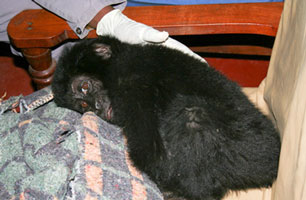
Ihirwe, an infant mountain gorilla, rests after being rescued from poachers by Rwandan authorities on Sunday. Mountain Gorilla Veterinary Project
It’s easy enough to get the public interested in the great apes when you plaster James Franco’s handsome face on a movie poster and promise visual effects on the level of Lord of the Rings and King Kong. But these animals get other types of attention too – the wrong kind. On Sunday a baby mountain gorilla named Ihirwe was rescued from the clutches of poachers trying to smuggle her into Rwanda from the Democratic Republic of Congo, mostly to be traded as a pet or sold and butchered for some of her parts.
“The good news is that this infant was rescued before it was too late and is now in good hands,” Eugène Rutagarama, director of the International Gorilla Conservation Program (IGCP), said in a statement. “The bad news is that people believe there is a market for baby mountain gorillas and are willing to break laws and jeopardize the fate of a critically-endangered species at the chance for profit.”
More from Ecocentric: Why the Apes Aren’t Going to Rise
Thankfully things turned out well for Ihirwe – she was found alive, is under the watchful eyes of caregivers at a Rwandan facility, and will soon join fellow orphan gorillas Maisha, Kaboko, Ndeze, and Ndakasi at Virunga National Park’s Senkwekwe Center in the DRC. “We are cautiously optimistic for this little one – she is tense, but accepting of people, and is eating. All good signs for her eventual recovery,” Jan Ramer of the Mountain Gorilla Veterinary Project said in a statement. And Ihirwe can rest assured that her poachers – a group of Rwandan and Congolese men – won’t be back: they’ve been taken into custody in Rwanda, and a serious investigation into a possible bigger network of poachers is underway.
But Ihirwe is one of the lucky ones – most gorillas that fall victim to poachers aren’t so fortunate. She’s also one of the only 786 mountain gorillas believed to remain in the mountains of Rwanda, Uganda, and the DRC. With habitat destruction, regional conflict, and hunting to deal with, it’s no wonder the gorillas are listed as Critically Endangered in the IUCN’s Red List of Threatened Species. And then there’s also the issue of just how baby gorillas like Ihirwe are captured: at the expense of other, older gorillas.
“The normal way that infant gorillas are taken into captivity by poachers is that the adults in the group are killed,” WWF‘s African Species Program head Matthew Lewis says. “Obviously the mother isn’t going to hand over the infant – she will fight tooth and nail for them.” Typically the poachers have to shoot the mother – and the other family members helping her out – to get their hands on the infant, a practice which causes hundreds of gorillas to die unnecessarily and will eventually wipe the creatures out in the wild. And life is no picnic for the kidnapped infant gorillas who do survive. They become pets to the select few who don’t realize that their cute baby gorilla, small and entirely manageable at first, will grow up to become a hulking wild animal weighing up to 350 pounds and needing a steady supply of shoots and stems found in the jungle. “It never ends well,” Lewis said.
But unfortunate as this gorillas-as-pets trade is, activists like Lewis have a difficult task ahead. It’s difficult to figure out where the demand is coming from because so much of the trade happens under the table. This makes targeted awareness campaigns of the kind used with other environmental problems tough to administer. “You really don’t know who your audience is – it’s not wide,” Lewis said. Stepping up law enforcement and doling out punishments on par with the level of crime this trade entails is what Lewis hopes to see, and soon. Ihirwe means “luck” in Kinyarwanda – we can only hope her fellow gorillas will have as much of it as she did.
Tara Thean is a TIME contributor. Find her on Twitter at @TaraThean. You can also continue the discussion on TIME‘s Facebook page and on Twitter at @TIME.
More from Ecocentric: Melting Arctic Ice Takes Its Toll on Polar Bear Cubs
Photos from TIME: See a brief history of the “Planet of the Apes” franchise.