



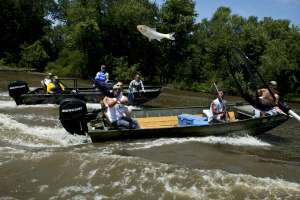
Gunning for Asian carp at the 2010 Redneck Fishing Tournament Credit: Benjamin Lowy—Getty Images News
Dedicated followers of this blog—thanks both of you—know that one of my areas of obsession is invasive species. That’s partially because they’re so often funny—example number one being the flying Asian carp, which I’ll get to in a moment. But invasives are a biological and visible consequence of our ultra-connected world, a symptom of humanity’s habit of redrawing the borders of the nature—and a reminder that there can always unintended results when we start meddling with the wild.
Beyond the natural philosophy, however, invasive species can be very, very expensive. Invasive plants like the English ivy and animals like the Rocky Mountain pine beetle Burmese python can cause up to $120 billion worth of damage each year, and vast chunks of the budgets of government agencies like the Fish and Wildlife Service are dedicated to finding and rooting out invaders. Yet despite the cost, far too little is done to prevent invasive species from invading our borders in the first place. The U.S. receives hundreds of non-native species every year via international trade—often through the exotic pet trade—yet we rarely stop to figure out which of those species might post an invasive threat. The chief piece of legislation governing the wildlife trade—the 111-year-old Lacey Act—only lists 25 restricted species, and most of those were only listed after they’d broken free and established themselves. “Essentially we have an open-door policy when it comes to the live animal trade,” says Michael Springborn, an environmental scientist at the University of California-Davis.
More from TIME: Lake Invaders
Of course, assessing new species for their invasive risk—something already done by countries like Australia, New Zealand and Israel—would add costs, but a new study being published in the journal Ecological Economic suggests that the money would be well spent. A team of researchers led by Springborn looked at over a decade of data on reptiles and amphibians imported to the U.S., and found that the net benefits of a risk screening system ranged from approximately $54,000 to $150,000 per species assessed. The conclusion is pretty clear—it pays off to prevent invasive species from invading in the first place. “The right policy is a mix of prevention, and then response if prevention fails,” says Springborn. “We’d be more effective if we acted proactively.”
A better invasives policy would likely require new legislation and a modernization of the old Lacey Act—something that Senator Bill Nelson of Florida, a border state at tremendous risk for invasions, has tried to pioneer. As Peter Jenkins of the National Environmental Coalition on Invasive Species said in a statement:
The old saying ‘an ounce of prevention is worth a pound of cure’ was ahead of its time when it comes to invasive species policy. This economics study provides Congress with strong financial justification to adopt a thorough risk assessment approach for live animal imports coming into this country.
Video from TIME: Holy Carp!
Of course, risk assessment won’t completely eliminate the threat of invasive species. Some of the most devastating invaders have come in accidentally, like the zebra mussel, which hitched a ride in the ballast water of container ships before invading the Great Lakes. But more picky policy might have stopped the Asian carp, which was imported by Midwestern fish farmers in the 1970s escaping into the Mississippi River system during floods. Now the carp are threatening the Great Lakes. So far, according to genetic data, they haven’t established themselves in Lake Michigan yet, but millions have been spent by federal and state agencies trying to control their numbers, with little luck. At the annual Redneck Fishing Tournament in Bath, Illinois last weekend, hundreds of fishermen netted nearly 9,000 carp—or roughly the number of Budweiser cans the participants likely plowed through. It would have been a lot cheaper to prevent the Asian carp from invading the Mississippi in the first place—though having been to the Redneck Fishing Tournament, I can say that it might not have been as much fun.
More from Ecocentric: Happy National Invasive Species Week
Bryan Walsh is a senior writer at TIME. Find him on Twitter at @bryanrwalsh. You can also continue the discussion on TIME’s Facebook page and on Twitter at @TIME.