



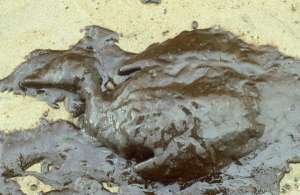
Oxford Scientific / Getty Images
From TIME contributor Joe Jackson:
As oil gushed into the Gulf of Mexico from BP’s Deepwater Horizon rig in May 2010, and then CEO Tony Hayward made his infamous statement that he wanted his life back, he likely had little fear of it being taken in a court of law.
But that reality could be changing as a movement to make business executives and political leaders legally accountable for environmental destruction gains global momentum. Campaigners are calling for the introduction of a new internationalized law of ecocide – the mass destruction of ecosystems – that would be on a par with genocide and similar crimes against humanity.
In late September the Hamilton Group – an NGO promoting sustainable development – staged a mock trial at the U.K.’s Supreme Court. The day-long proceedings saw two fictional oil company execs – played by actors – face three counts of ecocide. Their multinationals stood accused of killing migratory birds and degrading the environment in the Deepwater Horizon oil spill and in the tar sands in Canada, with the pair facing a volunteer jury, one supposedly screened to be free of activists.
“We took it very seriously,” says jury foreman Huw Spanner, a 51-year-old writer and editor. “It seemed a mixed group – there were some green skeptics,” he adds of the jury.
Their unanimous convictions on two of the three charges were perhaps a meaningless victory for Greens given that the proceedings – despite being based on real events and featuring genuine barristers, expert witnesses and a judge – were entirely devoid of legal status.
More from TIME: How to Clean Up the Mess
But those involved insist it provides a telling example of how an ecocide law could operate in practice.
“It wasn’t clear exactly where the borderlines of ecocide were,” explains Spanner. “[But] that kind of lack of clarity didn’t affect us because these actual charges were so well within any definition…the toxic lakes [in the Tar Sands] are just so monstrous.”
There is little doubt that most companies are not currently held responsible for the environmental cost of their actions. A U.N.-commissioned report released last year found that if the 3,000 biggest public companies in the world were required to pay the cost of pollution and environmental damage they caused, it would drain more than a third of their profits.
Photos from TIME: The Oil Spill Spreads
British lawyer-turned-campaigner Polly Higgins, who helped to organize the mock trial, is spearheading the campaign to define ecocide as the fifth international crime against peace and make it prosecutable in the International Criminal Court (ICC). The law would target those with “superior responsibility” for our planet’s environment – and include heads of state, as well as executives of banks and industrial companies.
The Hague-based court currently hears only four crimes: genocide, war crimes, crimes of aggression, and crimes against humanity. It will be no easy feat to add ecocide to that roster. Such a move requires the amendment of the ICC’s governing Rome Statute and would need the backing of two-thirds of the 117 countries recognizing the ICC (as of Nov. 1, 2011.) That means Higgins must convince 78 heads of state to back a law that, not incidentally, could leave them open to prosecution.
“This is definitely manageable,” she tells TIME. “You’re looking at, in truth, under 100 people needing to put their minds to this – it just so happens they’re heads of state.”
More from TIME: Costs of the Oil Spill
Higgins won’t confide how many countries she has on board or specify which she has met. But she claims to have encountered “a heck of a lot of engagement” with a diverse range of governments from different continents and, not surprisingly, from small island nations in particular.
The lawyer, author of the award-winning book Eradicating Ecocide, believes the recent stalemate in climate change negotiations has shown current approaches to environmental issues are redundant and that an entirely new, punitive system is required.
“It’s just not possible to get anything done by the lowest common denominator so creating sanctions is quite a different game. Once we start to criminalize it, compliance becomes the norm rather than the exception,” she argues, pointing to historical examples of injustice such as slavery.
The chances of consensus around an ecocide law may be improved by the fact that it is not solely about climate change – a politically divisive issue in the U.S.
“You can be a climate denier and still get what I’m talking about,” she says. “For the purpose of establishing ecocide as a crime we don’t have to prove it’s climate change and that’s very important here.”
In 2009 Higgins succeeded in persuading the U.N. to draw up a Universal Declaration for Planetary Rights based on the human rights charter. Meanwhile, last year she submitted a legal proposal for ecocide to the International Law Commission that could progress as a U.N. resolution through a vote at the General Assembly. But her attention is instead turning to a potentially faster route to an ecocide law at next year’s Earth Summit gathering of world leaders in Rio de Janeiro.
“There’s going to be a lot of pressure on governments and they’re aware they’re going to have to come up with something,” she says, adding: “If you look across history and the evolution of legislation at the top level, we get to a certain point where the moral imperative trumps the economic imperative.”
But with the global economy still in the doldrums and a U.S. presidential election on the horizon, only the most optimistic would bet on it in the short-term.
More from Ecocentric: Can Ecuador Trade Oil for Forests?
Joe Jackson is a contributor for TIME. You can also continue the discussion on TIME’s Facebook page and on Twitter at @TIME