



Zebras roam freely in Nairobi National Park, located just outside of the country's capital, in Nairobi, Kenya. (Photo: Peter Macdiarmid / Getty Images)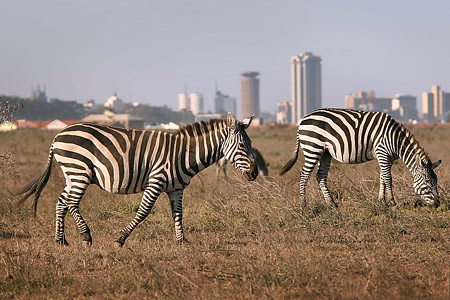
Maybe it’s just the fact that the official day has been set for October 31—Halloween—but there’s a distinct whiff of panic and fear around the expected birth of the 7 billionth person on the planet. Here’s Roger Martin, chair of the NGO Population Matters, writing in the Guardian recently:
The 7 Billion Day is a sobering reminder of our planet’s predicament. We are increasing by 10,000 an hour. The median UN forecast is 9.3 billion by 2050, but the range varies by 2.5 billion – the total world population in 1950 – depending on how we work it out.
Every additional person needs food, water and energy, and produces more waste and pollution, so ratchets up our total impact on the planet, and ratchets down everyone else’s share – the rich far more than the poor. By definition, total impact and consumption are worked out by measuring the average per person multiplied by the number of people. Thus all environmental (and many economic and social) problems are easier to solve with fewer people, and ultimately impossible with ever more.
Until the 7 billion threshold was approached recently, population growth had largely disappeared as a major international issue—a far cry from the 1970s, when Malthusian thought was back in fashion and countries like India and China were taking brutally coercive steps to curb population growth. That’s partially a reaction to those dark days—right-thinking environmentalists didn’t want to be associated with unjust policies, and so population became the green issue that dare not speak its name. But I also think that when the 6 billionth person rolled around—just 12 years ago—the world was in a very different and much brighter place. It’s a lot easier to feel sunny about the idea of the planet growing more crowded when the global economy is humming, there are few major conflicts ongoing and you can bring a water bottle through airport security.
Things, of course, are a little darker in 2011, so suddenly more people just seem like more mouths to feed, more competitors at the marketplace, more straws in the milkshake. You can see it in the way that immigration has once again become a hot-button political issue in the U.S., or the rise of population-induced apocalyptic fears. Are we going to breed ourselves out of existence? Is there room on the planet to support 7 billion plus people?
More from TIME: Welcome to the Era of the Everyday Billion-Dollar Disaster
Take a deep breath. The answer is yes—and not just because you could fit 7 billion people in the state of Texas and it would only have the population density of New York City, which I can tell you from personal experience isn’t that bad. We’re a long way from Soylent Green territory here. As Joel Cohen of Rockefeller University pointed out in the New York Times recently, we have more than enough food, water and other essentials to keep every one of the 7 billion—and far more—perfectly healthy:
In fact, the world is physically capable of feeding, sheltering and enriching many more people in the short term. Between 1820, at the dawn of the industrial age, and 2008, when the world economy entered recession, economic output per person increased elevenfold.
Life expectancy tripled in the last few thousand years, to a global average of nearly 70 years. The average number of children per woman fell worldwide to about 2.5 now from 5 in 1950. The world’s population is growing at 1.1 percent per year, half the peak rate in the 1960s. The slowing growth rate enables families and societies to focus on the well-being of their children rather than the quantity.
It’s not sheer population growth that is stressing out the planet—it’s what those people are producing and consuming. It’s notable that much of the concern over population growth tends to focus on sub-Saharan Africa and the developing world. That may be where population is growing fastest, but poor Ugandans and Nigerians use a tiny proportion of the world’s resources compared to rich Westerners, even if our populations have begun to stabilize. Here’s how Jared Diamond—of Guns, Germs and Steel fame—laid out the issue in 2008:
The population especially of the developing world is growing, and some people remain fixated on this. They note that populations of countries like Kenya are growing rapidly, and they say that’s a big problem. Yes, it is a problem for Kenya’s more than 30 million people, but it’s not a burden on the whole world, because Kenyans consume so little. (Their relative per capita rate is 1.) A real problem for the world is that each of us 300 million Americans consumes as much as 32 Kenyans. With 10 times the population, the United States consumes 320 times more resources than Kenya does.
More from TIME: The Numbers Game
A billion people—that’s one in seven—go hungry around the world today, but that’s not because the planet is incapable of producing enough food to feed them. After all, as much as half the food produced worldwide ends up wasted, either rotting in the fields, the markets or in our refrigerator. We could feed 7 billion, 8 billion, 9 billion and probably more—if we choose to do so.
That’s one of the reasons I’m relatively sanguine about the population issue. It’s basically impossible to predict the future, and past performance is no guarantee of future results. But humanity has been pretty good so far at responding to the challenges this planet puts before us, and I see little reason to expect that will change. More people, after all, does mean more potential problem solvers, not just more mouths to feed.
But there’s an undeniable cost to all these people and all this growth: the planet itself. Even as human beings have grown in numbers and wealth, becoming healthier and more robust, other species have suffered. A study last year in Science found that on average, 52 species of mammals, birds and amphibians move one category closer to extinction every year. Almost one-fifth of existing vertebrates species are threatened, including some 41% of amphibians. Another recent Science study found that human beings are destroying apex predators like tigers, wolves or sharks, which then has a major knock on effect down the food chain.
Photos from TIME: World AIDS Day
And as our numbers increase, other species decrease. A Nature study found that we are already entering a period of historic extinctions—perhaps the sixth great “extinction wave.” It’s doesn’t seem to matter that we keep putting more and more of the planet under protection for nature. Our sheer numbers—and our material needs, our carbon emissions, our waste—leaves less and less room for other species, or at least, species that don’t depend directly on us like domestic animals and pests.
We may be headed towards a planet that supports 7 billion, 8 billion, 9 billion people—but not much else. It’s not exactly the overpopulated apocalypse that science fiction and some environmentalists would have us fear, but it would still be an incalculably lessened world.
More from TIME: Getting Paid to Procreate
Bryan Walsh is a senior writer at TIME. Find him on Twitter at @bryanrwalsh. You can also continue the discussion on TIME’s Facebook page and on Twitter at @TIME.