



A hill in Canada's Northwest Territories slumps from melting permafrost. (Rick Bowmer / AP)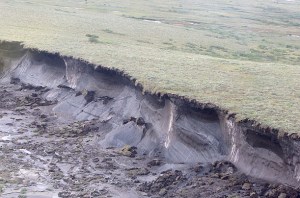
One of those wild cards is the 1,672 billion tonnes of carbon equivalent trapped in the form of methane in the Arctic permafrost, the soils kept frozen by the far North’s extreme temperatures. Methane is a powerful greenhouse gas—it has 20 times the warming effect of carbon dioxide—and the total amount of carbon equivalent in the Arctic permafrost is 250 times greater than annual U.S. greenhouse gas emissions. As the Arctic warms—which it’s doing rather rapidly—there’s a risk that the permafrost could become less than permanent, releasing some of that trapped methane into the air, which would then accelerate warming, leading to more Arctic melt, more methane emissions…so on and so on. Climate scientists call this a “feedback loop“—and if it happens soon, you could just call us screwed.
More from TIME: Arctic Sea Ice Shrinks to Second-Lowest Level on Record
According to a new study published in the November 6 Nature, that wild card is still wild. Researchers from the U.S. Geological Survey, the U.S. Department of Energy Joint Genome Institute and other institutions used metagenomic sequencing to study the permafrost, trying to determine how the microbes within the land might respond to thawing. The scientists drilled 3 ft. long-core samples of soil in Hess Creek, Alaska—the bottom two-thirds of which contains permafrost soil. Each samples was thawed at 5C and then sent for genetic analysis.
The team found almost 40 billion elements of raw DNA, which shows just how rich in life the permafrost really is. For the first two days after thawing, the melting ice released the methane that had been trapped within, but then the rate of emissions dropped significantly. That seems to be due to the fact that while some microbes in the soil went onto produce more methane, other microorganisms actually consumed the gas. The metagentic analysis done on the Arctic soil showed a novel and complex microbial system that responded dynamically to changes in temperatures and to the release of methane stored in the soil, as Lawrence Berkeley National Laboratory researcher Janet Jansson put it:
By applying metagenomics to study microbial community composition and function, we can help to answer questions about how the currently uncultivated and unstudied microbial species residing in permafrost cycle organic carbon and release greenhouse gases during thaw. This will provide valuable information that could lead to improved carbon cycle models and eventual mitigation strategies.
In other words, as our scientific tools improve, our ability to better understand how complex and important systems like the Arctic permafrost are likely to respond to warming will improve as well. The only problem is that we’re putting carbon into the atmosphere even faster than our science is progressing—which means we’re still flying into the future nearly blind.
Photos from TIME: Greenland Odyssey
Bryan Walsh is a senior writer at TIME. Find him on Twitter at @bryanrwalsh. You can also continue the discussion on TIME’s Facebook page and on Twitter at @TIME