



Bloomberg / Getty Images
The good people of Oklahoma were rattled on Nov. 5 when the state was hit by its largest earthquake on record, a 5.6-magnitude temblor that struck 44 miles (71 km) east of Oklahoma City. (The previous biggest quake was a 5.5-magnitude tremor that hit in 1952.) Fortunately, no one was hurt, although 14 homes were damaged, and the state was shaken by a number of moderate aftershocks.
Oklahoma isn’t California — this is a state that is usually pretty seismically stable, one with about 50 small quakes a year until 2009. But the number of quakes spiked in 2009, and last year 1,047 tremors shook Oklahoma. All of which begs the question: Has something changed to make the Sooner State unstable? Perhaps something like hydraulic fracturing?
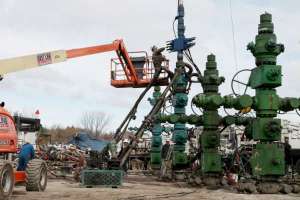
Also called fracking, the practice — producing small fractures in the earth miles beneath the surface with explosives in order to tap trapped oil and gas deposits — is common in Oklahoma, a center of the fossil fuel extraction industry. It’s not hard to wonder whether injecting millions of gallons of water, sand and chemicals deep underground in order to break up rock might worsen existing faults or even trigger a tremor.
(MORE: Can Shale Gas Power the World?)
There’s some evidence that fracking may induce minor tremors. A report (PDF) written earlier this year by Austin Holland of the Oklahoma State Geological Survey concluded that a swarm of about 50 very small quakes — from magnitudes 1.0 to 2.8 — may have been related to hydraulic fracturing. And just last week, a report financed by the U.K. energy company Cuadrilla Resources found “strong evidence” that two minor quakes and 48 weaker seismic events in Britain resulted from Cuadrilla’s fracking practices. Alexis Flynn of the Wall Street Journal reports:
The report could complicate efforts by privately held Cuadrilla to resume hydraulic-fracturing activity that was halted after the two seismic incidents.
The company said the report concluded that none of the events recorded, including one in April of 2.3 and one in May of 1.5 on the Richter scale, had any structural impact on the surface above.
But the quakes in England and earlier this year in Oklahoma were much smaller than the Nov. 5 temblor, which rocked the state 3 miles (4.8 km) underground, releasing the equivalent energy of 3,800 tons of TNT. Can fracking really trigger a quake that big?
(VIDEO: The Fuss over Fracking)
Experts say it’s unlikely, simply because fracking is so much less powerful. The Associated Press reports:
The typical energy released in tremors triggered by fracking “is the equivalent to a gallon of milk falling off the kitchen counter,” said Stanford University geophysicist Mark Zoback.
In Oklahoma, home to 185,000 drilling wells and hundreds of injection wells, the question of man-made seismic activity comes up quickly. But so far, federal, state and academic experts say readings show that the Oklahoma quakes were natural, following the lines of a long-known fault.
“There’s a fault there,” said U.S. Geological Survey seismologist Paul Earle. “You can have an earthquake that size anywhere east of the Rockies. You don’t need a huge fault to produce an earthquake that big. It’s uncommon, but not unexpected.”
That doesn’t leave fracking — and more broadly, oil and gas exploration — off the hook altogether when it comes to causing quakes. While the amount of energy used in a typical gas frack is tiny compared with the power of even a minor quake, there’s some evidence that in areas where far greater amounts of drilling wastewater has been injected deep underground — including states like Arkansas, Texas and Colorado — the process may put more stress on faults and help lead to stronger quakes. More from the AP report:
One issue is that areas that are prone to earthquakes are also places where oil and gas flow along fractures, experts said. In some studies, scientists have taken earthquake data and, like detectives, tracked its causes to deep injections of lots of liquid under high pressure, such as ones that peaked at magnitude 3.3 at the Dallas-Fort Worth airport in 2008 and 2009, said USGS geophysicist William Ellsworth. The Switzerland quake was in the city, Basel, so it did cause damage, he and others said.
The link between fracking and seismic activity is clearly worth studying — and the National Academy of Sciences is set to issue a report on the subject next year. But of all the concerns over the rapid spread of gas fracking — possible water contamination, the industrialization of the countryside, additional carbon emissions — man-made earthquakes seem pretty low.
MORE: 10 Questions for Daniel Yergin
Bryan Walsh is a senior writer at TIME. Find him on Twitter at @bryanrwalsh. You can also continue the discussion on TIME’s Facebook page and on Twitter at @TIME.