



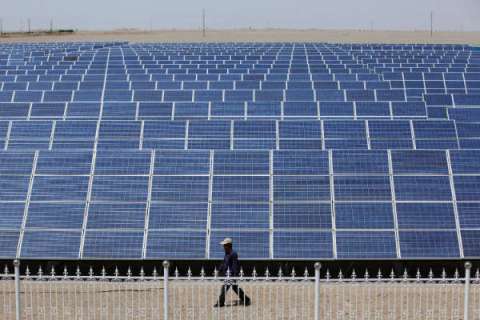
You might remember that a few weeks ago the U.S. Commerce Department opened up an investigation into alleged unfair trade practices by Chinese solar manufacturers. The investigation — instigated at the behest of some, though not all, U.S. solar manufacturers — had been brewing for some time, as Chinese solar companies were accused of essentially dumping panels at rock-bottom prices, aided by generous government subsidies.
There was little chance that China wasn’t going to respond. At the end of last week Beijing announced that it would start its own investigation of U.S. renewable-energy policy. From the New York Times:
More from TIME: How an Artificial Leaf Could Boost Solar Power
The announcement comes two weeks after the United States Department of Commerce said that it had accepted a request by SolarWorld Industries America and six other companies in the United States for an investigation into whether Chinese solar-panel manufacturers had obtained export subsidies from the Chinese government, or had dumped solar panels in the United States for less than it cost to manufacture and distribute them.
The difference here is that American exports of solar panels to China are almost nonexistent, in part because domestic companies are so dominant. So it’s hard to see the Chinese investigation as much more than retaliation. The Chinese government has said that the investigation will run until May 25, which would give Beijing time to launch retaliatory action if the U.S. does decide to slap tariffs on solar imports.
One way or another, this looks to be a major trade issue — especially considering how big the renewable-energy sector is getting. According to calculations by Bloomberg New Energy Finance, last year investment in renewable energy totaled $187 billion, compared with $157 billion for fossil fuels. That’s an important milestone, as U.N. Environment Programme head Achim Steiner told the Los Angeles Times:
The progress of renewables has been nothing short of remarkable. You have record investment in the midst of an economic and financial crisis.
More from TIME: The Fallout from Solyndra
With the annual U.N. climate summit about to get under way in the South African city of Durban, the news is well timed. But it’s worth noting that the past year has also seen ruinous price wars on solar and wind. That’s great for users — solar-panel prices have tumbled in recent months, which makes solar power that much more affordable.
But those low prices are cutting into the margins of renewable-energy companies, which is one reason why the WilderHill New Energy Index, which tracks renewable-power stocks, has dropped 40% this year. Low prices for solar and wind turbines are great, but renewable energy won’t be sustainable if companies can’t make money on it.
More from TIME: Green Jobs vs. Brown Jobs
Bryan Walsh is a senior writer at TIME. Find him on Twitter at @bryanrwalsh. You can also continue the discussion on TIME’s Facebook page and on Twitter at @TIME