



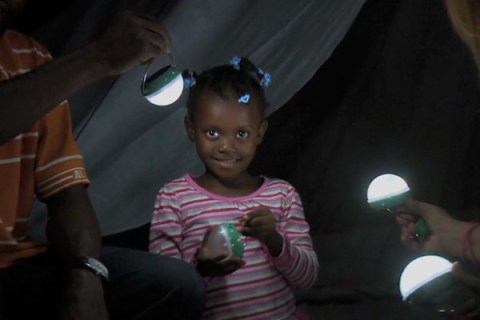
AGI Outreach Program delivered 250 solar bulbs to families in Haiti as seen in the documentary, City of Lights.
The sun will set early in Haiti tonight. By 5:23 PM, night will have come to the island nation, and while night comes to virtually every part of the world virtually everyday, throughout much of Haiti, the darkness will be much deeper.
It’s been nearly two years since the January 12, 2010 earthquake that killed perhaps 100,000 people and left up to 1.5 million homeless. Many of those survivors relocated to temporary tent cities — refugee centers that, as so often happens after natural disasters, became decidedly untemporary. Even now, roughly half a million homeless Haitians remain stuck in the muddy settlements — prey to disease, crime, and an enveloping despair. The list of what’s lacking in the tent cities is almost too long to compile, but near the top — in many respects at the top — is light.
Without light, makeshift shops and stalls can’t stay open after dark, limiting the little bit of commercial enterprise that has bloomed in the camps. Without light, children who have schools to attend during the day can neither read nor study at night. Without light, crime — and worse, sexual assault — can run riot.
“Light is a basic and fundamental source of safety,” says Leah Quintal, program coordinator for American Green International (AGI), a private group that works to bring sustainable technologies to the developing world. “Over half of the women and girls in the tent cities have been raped or sexually assaulted. That is not OK.”
The solution to the light problem — kerosene lamps — is actually no solution at all. Kerosene is expensive — far too expensive for people trying to get by on $1 per day. What’s more, it’s toxic when burned, filling tents with a poisonous exhaust that can be the pulmonary equivalent of smoking two packs of cigarettes a day. And it’s a fire hazard.
But there is an answer, and AGI is helping to provide it. For the past year, the group has been raising money to manufacture and distribute softball-sized solar-powered lights to the people in the Haitian tent cities. Hung on a clothes line and charged during the day, the bulbs store enough power to burn reliably at night, gently illuminating the interior of tents and, more importantly, the dark passageways between them. The bulbs have so far lifted only a tiny edge of the darkness. During AGI’s first visit last January, the group distributed just 250 lights — many to an orphanage, others to shopkeepers and a few to lucky families. But they are planning to return in February, with the goal of distributing 1,000 more, while trying to raise the needed funds to manufacture thousands and thousands more after that.
“It’s brilliant, literally,” said Quintal, during a presentation in November at a TEDx conference in Asheville, N.C., “that something so simple, just a little bit of light, [could be so] good.”
AGI is the brainchild of Kurt Mann, an independent filmmaker and owner of American Green Media, a production company that makes films about sustainable science and environmental activism. After 25 years of telling other people’s tales, Mann decided to create his own content — which is to say, have an environmental story of his own to tell. So two years ago, he partnered with inventor Steve Katsaros, who had developed the Nokero (for no kerosene) light bulb, designed to be used both for disaster relief and to help liberate more than 1.6 billion poor people worldwide from their dependence on kerosene. Haiti seemed like a perfect place to test drive the bulb.
The trip last January was significant not just because it showed how receptive the residents of the tent cities were to the new technology, but how much they could be helped by it. At New Life Children’s Orphanage, all of the children were given their own bulbs and told to write their names on them. In the evenings, after the bulbs had soaked up a day of sunlight, the kids would collect them from their clothesline and take them back to their dorms.
“Before we brought these lights,” said Quintal, “there was little they could do, because there was no electricity. Now, they can read, they can paint, they can do homework, they can have conversations where they can see one another. One boy came to us to thank us for the solar light, because he said as a result he was going to study harder and study longer so that one day he could ‘be the winner in life.'”
In case Quintal and the others needed a reminder of how fragile such progress is and how far they still have to go, on the other side of the walls of the orphanage — which is one of the only true buildings in the vicinity of the tent cities — armed guards are stationed to keep the children safe. “This is the first time I have seen a sawed-off shotgun being used for protection,” Quintal says.
It will not be easy to make Haiti safe enough for the guns at last to be put away. The Nokero bulbs cost $20 each to manufacture, though economies of scale should bring that price way down eventually. With less than two months to go before their February return to Haiti, however, the members of the AGI team are scrambling to raise the funds to buy even the 1,000 bulbs they’ve set as a target. For now, they’re counting mostly on their website store, where visitors are urged to spend $40 for a give-one-get-one deal in which one bulb will be sent to them and another hand-delivered to Haiti.
If the Nokero bulbs work in Haiti, they might serve just as well in the rest of the light-starved world. It’s a long way from 1,000 bulbs to 1.6 billion. But a single candle, as Eleanor Roosevelt famously observed — or, in this case, a single solar-powered light bulb — is a very good way to start.