



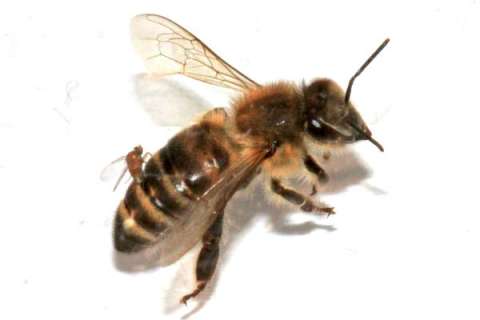
An A. borealis fly infecting a honeybee. The fly lays eggs inside the bee, causing the honeybee to act like a zombie before it is killed by the emerging fly larvae.
From the Nature Is Scary file: researchers from San Francisco State University announced this week in a new study that honeybees are being turned into “zombies” by parasite flies. The fly—known as Apocephalus borealis—deposits its eggs inside the abdomen of a bee. The action is fatal for the bee, as fly larvae eventually hatch and push their way out between the bee’s head and thorax. But that’s not the really gross part. Before the flies pop out, Alien-style, the bees start acting strangely, abandoning their hives to gather near lights, flying in a barely controlled fashion. They’re alive but not alive—bee zombies. And the parasites that cause the transformation may provide a clue to the mysterious colony collapse disorder (CCD) that has devastated honeybee populations in the U.S. over the past several years.
MORE: Wildlife: Where Have all the Bumblebees Gone?
The study—published in the journal PLoS ONE—was co-led by John Hafernik, a biology professor at SF State, and it came about by accident. Hafernik was searching for insects to feed the praying mantis he had brought back from a field trip, and found some dead bees underneath a light fixture outside his office building. He put them in a vial on his desk and promptly forgot about them for a few days. The next time he looked at the vial, however, he saw fly pupae surrounding the bees. Hafernik and Andrew Core—a SF State graduate student who led the PLoS ONE study—performed a genetic analysis on the flies and found they were the same species that had previously been shown to parasitize bumblebees and paper wasps. Honeybees, though, were a new target, and a surprising one, because the commercially valuable species—they pollinate crops worth some $15 billion a year—is intensively studied.
The SF State team surveyed local bee populations and found evidence of the fly in 77% of the hives they sampled in the Bay Area, as well as some hives in California’s heavily agricultural Central Valley and in South Dakota. That’s enough to add the parasite fly to the list of potential causes—mites, viruses, fungi—of CCD, which has seen some hives lose 30 to 90% of their bees without warning.
The research team will continue to study the parasite fly, tracking bees with radio tags and video cameras to see if the infected bees are being ejected forcibly from the hives—and to discover where the flies are finding their target bees, as Katharine Harmon writes in Scientific American:
“We assume it’s while the bees are out foraging because we don’t see the flies hanging around the bee hives,” Hafernik said. “But it’s still a bit of a black hole in terms of where it’s actually happening.” Most of the parasitized bees found so far have been foraging worker bees, but even if other groups of bees within a hive are not becoming infected, a decline in the number of foragers in a hive could have a large impact on a hive as a whole. Models of colony dynamics suggest that “significant loss of foragers could cause rapid population decline and colony collapse,” the researchers noted in their paper.
It’s the Buzzing Undead.