



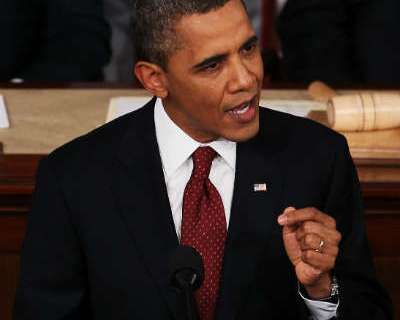
Well, he mentioned the ‘c’ word this year. Last year President Obama raised more than a few eyebrows when he failed to talk about climate change during his State of the Union—something even his Republican predecessor George W. Bush, no friend of the environment, usually managed to work in. But last night Obama did cite climate change, albeit in a rather roundabout way, criticizing Congress for being too deeply divided to pass comprehensive climate legislation—or for that matter, the clean energy standard that was a central piece of his 2011 State of the Union speech. So the President does remember how to say the word “climate.”
But global warming was barely a passing reference in the speech—quite unlike something that surely has many greens worried: a call to increase domestic oil and gas production.
In Obama’s words:
Nowhere is the promise of innovation greater than in American-made energy. Over the last three years, we’ve opened millions of new acres for oil and gas exploration, and tonight, I’m directing my Administration to open more than 75 percent of our potential offshore oil and gas resources. Right now, American oil production is the highest that it’s been in eight years. That’s right – eight years. Not only that – last year, we relied less on foreign oil than in any of the past sixteen years.
It’s true that the President went onto admit that the U.S. has only 2% of proven global oil reserves, and that there’s no way to drill ourselves out of the economic doldrums. But still, coming less than a week after the Administration blocked the oil sands Keystone XL pipeline, it was striking to see a President who had come to office promising to make clean energy and climate change a top priority.
Certainly that’s how Greenpeace saw it in their reaction to the speech:
President Obama announced a potential environmental nightmare when he called tonight for more than 75% of offshore oil and gas resources to be exploited. The President claimed he would not compromise on oil spills, but he has approved oil exploration in the Arctic, which his own Coast Guard says will be a “nightmare scenario” when an oil spill happens.
In fairness, Obama spent time on clean energy as well, calling for enough expedited development of wind and solar on public lands to power three million homes, and hyping the growing American battery industry:
What’s true for natural gas is true for clean energy. In three years, our partnership with the private sector has already positioned America to be the world’s leading manufacturer of high-tech batteries. Because of federal investments, renewable energy use has nearly doubled. And thousands of Americans have jobs because of it.
When Bryan Ritterby was laid off from his job making furniture, he said he worried that at 55, no one would give him a second chance. But he found work at Energetx, a wind turbine manufacturer in Michigan. Before the recession, the factory only made luxury yachts. Today, it’s hiring workers like Bryan, who said, “I’m proud to be working in the industry of the future.”
Obama also reiterated a call to end subsidies for oil companies, and to pass the clean energy standard—which would mandate that a certain percentage of U.S. energy must come from clean sources, including natural gas—that he called for last year. That went nowhere, and it’s hard to see a better chance during an election year. But it does allow Obama to draw a distinction between his own energy policies and those of the Republicans—even if some greens think that there’s far too little daylight between them.
Republicans, though, would disagree, as Indiana Governor Mitch Daniels said in his official response to the speech:
The extremism that stifles the development of homegrown energy, or cancels a perfectly safe pipeline that would employ tens of thousands, or jacks up consumer utility bills for no improvement in either human health or world temperature, is a pro-poverty policy. It must be replaced by a passionate pro-growth approach that breaks all ties and calls all close ones in favor of private sector jobs that restore opportunity for all and generate the public revenues to pay our bills.
Daniels is talking about the Keystone XL pipeline, which you can bet the Republicans will bring up over and over again in the year to come, as a symbol of Obama bending to green interests over domestic energy and domestic jobs. It’s not true that the Keystone pipeline would have employed tens of thousands of Americans—a few thousand is more like it—but the project does make for a good litmus test.
The Republican Party has been very clear about the fact that, as Daniels puts it, when it comes to domestic oil and gas projects, they’ll keep the green light on in the face of worries over local pollution or climate change. Obama—while he recognizes the economic value of the domestic oil and gas industry—isn’t so inclined, and his Environmental Protection Agency and Interior Department have been willing to curtail some of that development when public health and the environment comes under threat. Both sides want to lay claim to the “all of the above” energy strategy, but neither really does—Republicans have little interest in a government role to boost alternative energy, and Obama still has some red lines he won’t cross on fossil fuel development.
Greens are still less than happy with the President—and compared to the candidate he was in 2008, they have a right to be—but next November will still present a clear choice on where the country should head on energy and the environment. And at this point, I have no idea what the American public will choose.