New tests show traces of radioactive elements in Japanese baby food, forcing the recall of more than 400,000 cans of infant formula. The news underscores the challenges still facing Japan’s food sector nine months after the …
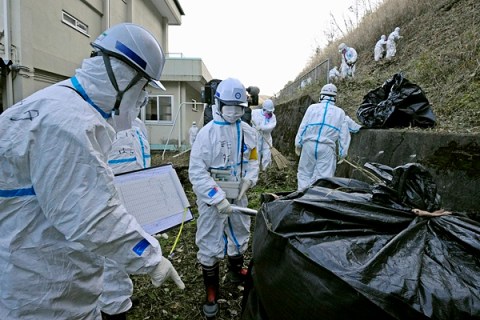
Keizo Ishii grabs a dosimeter from a table and strides over to a lump of uprooted grass. It’s a blazing August day in Fukushima City. The professor of nuclear engineering, an with the aura of a mad scientist as sweat drips from his brow and gray hair wisps out from under his baseball cap, has come from Tohoku University in Sendai to …
Call it slipper security. To get clearance into the food radiation testing center at Fukushima Agricultural Technology Center, you have to change shoes three times. The first time, you get a black pair. The second time, after your heels are scanned by a Geiger counter and deemed radiation-free, you change into a pair of plastic house …
In many ways, it looks like daily life in Fukushima is slipping back into its familiar routines. In Koriyama, a town south of Fukushima City, a group of taiko drummers set up in front of the train station to perform in an annual summer festival. Girls cruise by on bicycles in their plaid skirts and white socks in the unusually mild …
A newly released document says the Japanese government estimated in April that some 1600 workers will be exposed to high levels of radiation in the course of handling the reactor meltdowns at the stricken Fukushima Dai-ichi nuclear power plant.
The figure was released in a document from the Ministry of Economy, Trade and Industry …
If you’re eating a food that came in a wrapper while reading this, you probably eating palm oil — at least there’s a 50/50 chance you are. About half the packaged food found in a supermarket contains palm oil, according to the World Wildlife Fund, and a lot of that product comes from the lush archipelago of Indonesia.
In 2007, I …
The word ‘famine’ may be a familiar one, but it is not thrown around lightly by the people who decide when there is one. The fact that most of us today probably associate the term with the 1984 crisis in Ethiopia is testament to its exceedingly careful dispensation; to use it too often would dilute its power to command the attention …
Another disgruntled Japanese official has taken to the interwebs to air his grievances about the inadequate attention being paid to the welfare of residents of Minamisoma, a town about 25 kilometers away from the stricken Fukushima Dai-ichi nuclear power plant. Minamisoma last grabbed international headlines when the town’s mayor posted …
Over 950 pounds of beef contaminated with radioactive cesium above the legal limit has been distributed and eaten in at least eight prefectures across Japan, Tokyo city authorities have announced. The beef, which came from cows raised on a farm in Minamisoma in Fukushima prefecture, contained cesium at a level of 3,240 becquerels per …
Nobody likes a 40-year heat wave, but a 40-year heat wave in the midst of national drive to conserve energy seems particularly cruel. Last month, residents of Tokyo and other parts of Japan, where electricity is in short supply after March 11, endured highs of 95 degrees — and pangs of guilt when they reached to turn the …

 EcocentricEcocentric