



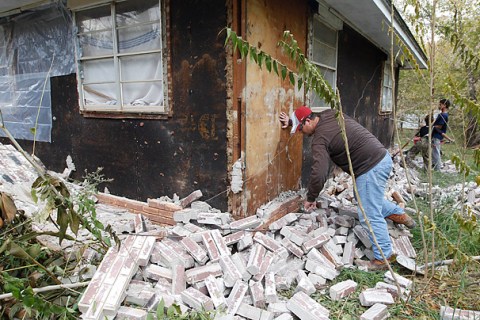
A house damaged in a pair of earthquakes that struck Sparks, Okla., Nov. 6, 2011, in less than 24 hours. Scientists have connected fracking to quakes, but it's less certain how severe they will be.
We already know that hydraulic fracturing—the process of injecting millions of gallons of water and chemicals deep into the earth to exploit the natural gas trapped inside rock—can likely help cause earthquakes. The British energy company Cuadrilla Resources admitted earlier this year that fracking operations caused a series of small quakes in Lancashire, and scientists have raised concerns about an unusual number and strength of quakes that hit this fall in Oklahoma, a state that has long embraced fracking. Environmentalists are already worried about the risk of water contamination and air pollution from fracking and shale gas drilling—do we need to fear quakes as well?
(MORE: Could Shale Gas Power the World?)
Probably not, at least according to a new model presented at the annual meeting of the American Geophysical Union in San Francisco last week. Arthur McGarr, a geologist with the U.S. Geological Survey in California, presented a paper that outlined a method to calculate the highest magnitude earthquake that fracking might be able to induce. McGarr and his team studied several cases of earthquakes apparently induced by fracking and other methods that involved injecting fluid into the ground, including a shale gas operation in Oklahoma and a geothermal-energy project in Switzerland.
The researchers found a proportional relationship between the volume of fluid injected into the ground and the strength of the resulting quake, as McGarr told Nature:
“If you inject about 10,000 cubic metres, then the maximum sized earthquake would be about a magnitude 3.3,” says McGarr. Every time the volume of water doubles, the maximum magnitude of any quake rises by roughly 0.4. “The earthquakes may end up being much smaller, but you want to be prepared for the worst-case scenario,” says McGarr. The relationship is straightforward, but it is the first time that anyone has quantified it, he adds.
It’s worth noting that 20,000 cubic meters of fluid would be about 5 million gallons—that’s roughly how much fluid is used in an average frack in Pennsylvania’s Marcellus Shale. So it seems unlikely that fracking for shale gas would cause severe quakes. But McGarr’s formula only calculates how strong a frack-induced quake would be—not how likely it is to occur. That would depend on other factors, including the depth of the frack and the strength of the rock layer.
But probability is what we really need to understand in order to calculate the local risk of fracking—and that’s not something we have yet. Still, while frack-induced quakes might be a worry, the growth of shale gas has bigger environmental concerns.
MORE: Contaminated? EPA Says Fracking “Likely” Affected Groundwater
Bryan Walsh is a senior writer at TIME. Find him on Twitter at @bryanrwalsh. You can also continue the discussion on TIME’s Facebook page and on Twitter at @TIME