



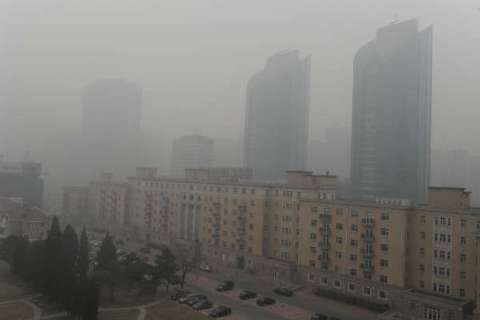
The smoggy Beijing skyline on January 18, 2012. China has struggled with worsening air pollution for years—and citizens are getting restless.
China confirmed this week that the number of its citizens living in cities has surpassed the rural population for the first time in its history. That massive urbanization — 690.79 million people are now city-dwellers according to the National Bureau of Statistics — has brought huge benefits, chief among them lifting hundreds of millions out of poverty. But it has also led to serious problems, perhaps none more so than the increasingly foul air in these heaving metropolises that are growing bigger, busier and dirtier by the day. In Beijing the situation has become so bad the capital’s airport has repeatedly been forced to close temporarily in recent months as dense smog prevented take-offs and landings. Meanwhile, the air has been so thick that residents have struggled to see across the road.
MORE: The China-U.S. Solar War Heats Up
Among the concerns about this well-documented public health hazard is the response — or, rather, lack of response — of the Chinese government. The controversy has centered on PM 2.5, the fine particles believed to pose the largest health risks since their small size (less than one-seventh the average width of a human hair) can lodge deeply into the lungs. The Beijing Municipal Environmental Monitoring Center has collected data on such particulate matter for the past five years but refused to make it public, preferring to release the readings of the larger PM 10 particles—which makes the air readings seem cleaner then they are.
This led to farcical situations where the government would declare the air ‘good’ or even ‘excellent’ when the opposite was true. After the U.S. embassy in downtown Beijing began releasing on Twitter hourly air quality measurements, including PM 2.5, from its rooftop monitoring station, the disparity between the two accounts was stark. In the first analysis of the embassy data on pollution, Steven Andrews, an environmental consultant based in Beijing, found in the last two years Beijing officials have announced good or even excellent air quality nearly 80% of the time, while the embassy has rated 80% of days with unhealthy levels of pollution.
Although Twitter is blocked in mainland China, Beijing residents can use virtual private networks to circumvent the censors and re-post findings on microblogs such as Sina Weibo. They can also use a mobile phone app that accesses the embassy feed, the Asia Times reports. Unsurprisingly, residents are unhappy about being kept in the dark. “As a Chinese citizen, we have been kept in the dark on this issue for too long,” Yu Ping, the father of a 7-year-old boy, who has started a public campaign to demand that officials report more accurately about Beijing’s air quality, told the New York Times last December.
MORE: Is Shark Fin Slowly Becoming Passé in Hong Kong?
Surprisingly, Beijing bowed to the pressure and began releasing hourly air pollution readings, now including PM 2.5 measurements, on Jan. 21. State news agency Xinhua reported that they wouldn’t stop there: “In keeping with other Chinese cities’ decisions to tell the public more about airborne pollutants, the bureau will also release data about sulfur dioxide, nitrogen dioxide and larger particles.” Hong Kong and Macau will also begin to include PM 2.5 data in their air monitoring and reporting systems. Hong Kong, which suffers from embarrassingly poor air, announced this week it would attempt to meet WHO air quality standards by 2014.
The releases shows a surprising degree of responsiveness from Communist Party officials. It also suggests that, despite their slow response, some portion of the country’s leaders do realize that the state of their cities’ air could have serious repercussions on economic growth, public health and social stability.
China, now the world’s largest carbon emitter, rightly gets a hard time for its pollution. But it rarely gets credit for its unilateral moves to deal with climate change. As the Economist notes, China is trying to improve air quality dramatically in a much shorter than the 25 to 35 years it took the U.S. and Europe in the aftermath of industrialization. It also noted that the U.S. only began reporting PM 2.5 in 2002 and the European Union followed suit six years later. The country has also exceeded its most recent ambitious targets for sulfur reductions.
Meanwhile, Chinese companies dominate the solar panel industry, thanks to hefty government investment, in both manufacturing and usage in the country itself and is increasing capacity rapidly. This week the country unveiled a Second National Assessment on Climate Change that did not shirk from acknowledging the challenges ahead. It acknowledged that global warming is fed by greenhouse gases and noted that shifting land-use threatens long-term health, prosperity and food supplies. That alone won’t clear the air but, in a time of climate change-denying GOP presidential candidates, you have to admire their honesty.